I. Conductors and Electric Potential
A small conducting spherical shell with inner radius a and outer
radius b is concentric with a larger conducting spherical shell with
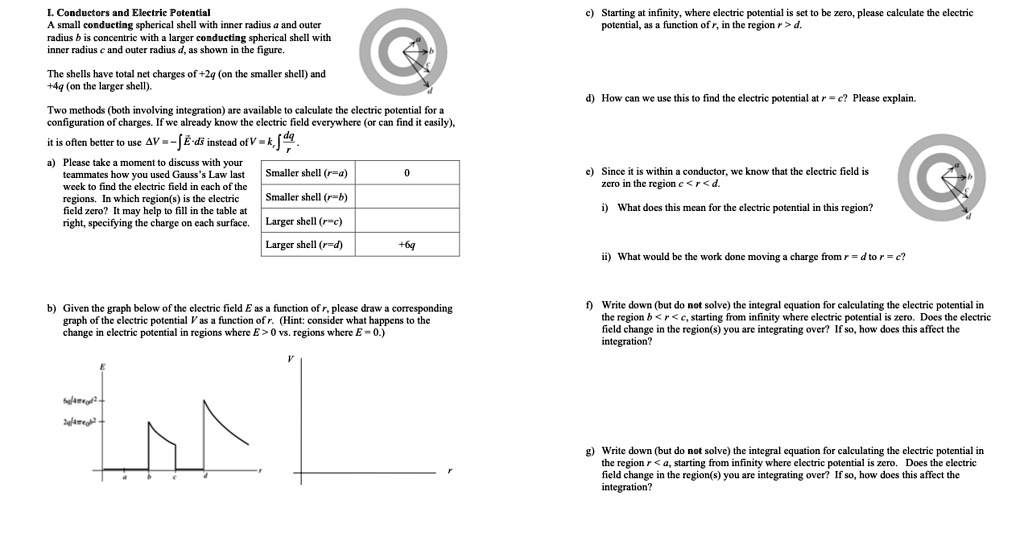
inner radius c and outer radius d, as shown in the figure.
The shells have total net charges of +2q (on the smaller shell) and
+4q (on the larger shell).
Two methods (both involving integration) are available to calculate the electric potential for a
configuration of charges. If we already know the electric field everywhere (or can find it easily),
it is often better to use Delta V=-int vec(E)*dvec(s) instead of V=k_(e)int (dq)/(r).
a) Please take a moment to discuss with your
teammates how you used Gauss's Law last
week to find the electric field in each of the
regions. In which region(s) is the electric
field zero? It may help to fill in the table at
right, specifying the charge on each surface.
b) Given the graph below of the electric field E as a function of r, please draw a corresponding
graph of the electric potential V as a function of r. (Hint: consider what happens to the
change in electric potential in regions where E>0 vs. regions where E=0.)
c) Starting at infinity, where electric potential is set to be zero, please calculate the electric
potential, as a function of r, in the region r>d.
d) How can we use this to find the electric potential at r=c ? Please explain.
e) Since it is within a conductor, we know that the electric field is
zero in the region r=dr=cr, starting from infinity where electric potential is zero. Does the electric
field change in the region(s) you are integrating over? If so, how does this affect the
integration?b, starting from infinity where electric potential is zero. Does the electric
field change in the region(s) you are integrating over? If so, how does this affect the
integration?
gc.
i
I.Conductors and Electric Potential A small conducting spherical shell with inner radius a and outer radius b is concentric with a larger conducting spherical shell with inner radius c and outer radius d, as shown in the figure.
c) Starting at infinity, where electric potential is set to be zero, please calculate the electric potential, as a function of r, in the region r > d.
The shells have total net charges of +2q (on the smaller shell) and +4q (on the larger shell).
d) How can we use this to find the electric potential at r = c? Please explain.
Two methods (both involving integration) are available to calculate the electric potential for a configuration of charges. If we already know the electric field everywhere (or can find it easily), it is often better to use V=E-d5 instead ofV=, J dq a)Please take a moment to discuss with your teammates how you used Gauss's Law last Smaller shell (r=) 0 week to find the electric field in each of the regions. In which region(s) is the electric Smaller shell (r=b) field zero? It may help to fill in the table at right, specifying the charge on each surface Larger shell (r=c)
e) Since it is within a conductor, we know that the electric ficld is zero in the region c < < d.
i) What does this mean for the electric potential in this region?
Larger shell (r=d)
+6q
ii) What would be the work done moving a charge from r = d to = c?
b) Given the graph below of the electric field E as a function of r, please draw a corresponding graph of the electric potential V as a function of r. (Hint: consider what happens to the change in clectric potential in regions where E > 0 vs. regions where E = 0.)
1 Write down (but do not solve) the integral equation for calculating the electric potential in the region b < < c, starting from infinity where electric potential is zero. Does the electric field change in the region(s) you are integrating over? If so, how does this affect the integration?
g40
g) Write down (but do not solve) the integral equation for calculating the electric potential in the region < , starting from infinity where electric potential is zero. Does the electric field change in the region(s) you are integrating over? If so, how does this affect the integration?