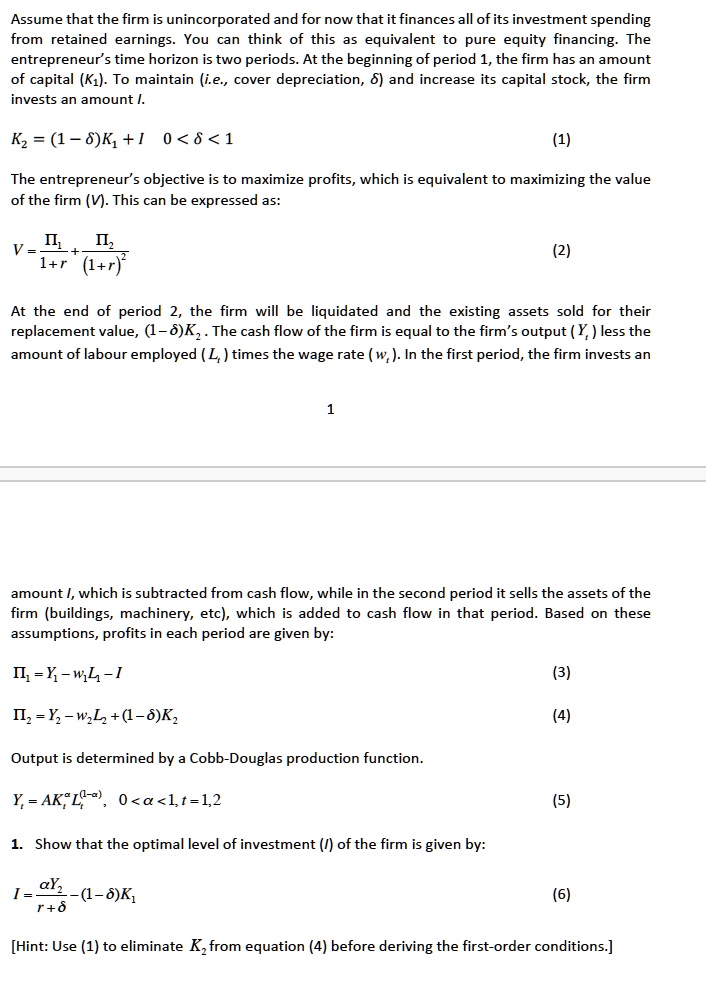
Assume that the firm is unincorporated and for now that it finances all of its investment spending
from retained earnings. You can think of this as equivalent to pure equity financing. The
entrepreneur's time horizon is two periods. At the beginning of period 1 , the firm has an amount
of capital (K_(1)). To maintain (i.e., cover depreciation, delta ) and increase its capital stock, the firm
invests an amount I.
K_(2)=(1-delta )K_(1)+I,0<delta <1
The entrepreneur's objective is to maximize profits, which is equivalent to maximizing the value
of the firm (V). This can be expressed as:
V=(Pi _(1))/(1+r)+(Pi _(2))/((1+r)^(2))
At the end of period 2, the firm will be liquidated and the existing assets sold for their
replacement value, (1-delta )K_(2). The cash flow of the firm is equal to the firm's output (Y_(t)) less the
amount of labour employed (L_(t)) times the wage rate (w_(t)). In the first period, the firm invests an
amount I, which is subtracted from cash flow, while in the second period it sells the assets of the
firm (buildings, machinery, etc), which is added to cash flow in that period. Based on these
assumptions, profits in each period are given by:
Pi _(1)=Y_(1)-w_(1)L_(1)-I
Pi _(2)=Y_(2)-w_(2)L_(2)+(1-delta )K_(2)
Output is determined by a Cobb-Douglas production function.
Y_(t)=AK_(t)^(alpha )L_(t)^((1-alpha )),0<alpha <1,t=1,2
Show that the optimal level of investment (I) of the firm is given by:
I=(alpha Y_(2))/(r+delta )-(1-delta )K_(1)
[Hint: Use (1) to eliminate K_(2) from equation (4) before deriving the first-order conditions.]
Assume that the firm is unincorporated and for now that it finances all of its investment spending from retained earnings. You can think of this as equivalent to pure equity financing. The entrepreneur's time horizon is two periods.At the beginning of period 1,the firm has an amount of capital (K). To maintain (i.e., cover depreciation, ) and increase its capital stock, the firm invests an amount I.
K=1-K+10<8<1
(1)
The entrepreneur's objective is to maximize profits,which is equivalent to maximizing the value of the firm (V). This can be expressed as:
II 112 V 1+r
(2)
At the end of period 2, the firm will be liguidated and the existing assets sold for their replacement value,(1-)K, . The cash flow of the firm is equal to the firm's output (Y) less the
amount of labour employed(L,) times the wage rate(w,). In the first period, the firm invests an
1
amount I,which is subtracted from cash flow,while in the second period it sells the assets of the firm (buildings, machinery, etc), which is added to cash flow in that period. Based on these assumptions, profits in each period are given by:
II=Y-wL-I
(3)
II=Y-wL+(1-K
(4)
Output is determined by a Cobb-Douglas production function
Y=AKL-,0<a<1,t=1,2
(5)
1. Show that the optimal level of investment (1 of the firm is given by
1-K r+o
(6)
[Hint:Use(1to eliminate K,from eguation (4before deriving the first-order conditions.]