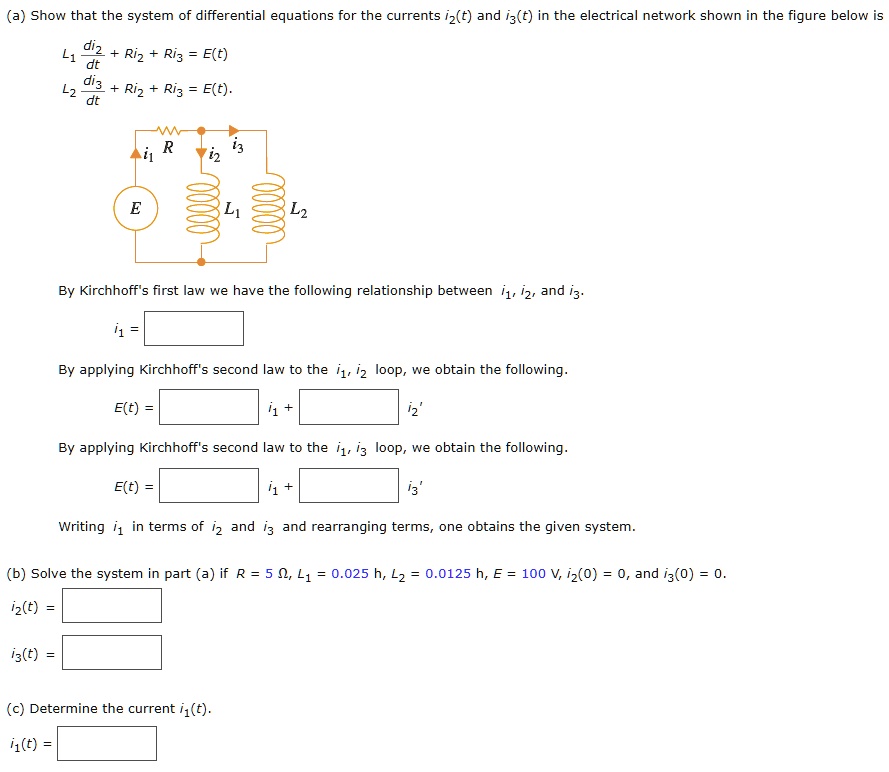
(a) Show that the system of differential equations for the currents $i_2(t)$ and $i_3(t)$ in the electrical network shown in the figure below is
$L_1 \frac{di_2}{dt} + Ri_2 + Ri_3 = E(t)$
$L_2 \frac{di_3}{dt} + Ri_2 + Ri_3 = E(t)$.
By Kirchhoff's first law we have the following relationship between $i_1$, $i_2$, and $i_3$.
$i_1 = \boxed{\phantom{i_2 + i_3}}$
By applying Kirchhoff's second law to the $i_1$, $i_2$ loop, we obtain the following.
$E(t) = \boxed{\phantom{Ri_1}} i_1 + \boxed{\phantom{L_1 \frac{di_2}{dt}}} i_2'$
By applying Kirchhoff's second law to the $i_1$, $i_3$ loop, we obtain the following.
$E(t) = \boxed{\phantom{Ri_1}} i_1 + \boxed{\phantom{L_2 \frac{di_3}{dt}}} i_3'$
Writing $i_1$ in terms of $i_2$ and $i_3$ and rearranging terms, one obtains the given system.
(b) Solve the system in part (a) if $R = 5 \ \Omega$, $L_1 = 0.025 \text{ h}$, $L_2 = 0.0125 \text{ h}$, $E = 100 \text{ V}$, $i_2(0) = 0$, and $i_3(0) = 0$.
$i_2(t) = \boxed{\phantom{20 - 20e^{-200t}}}$
$i_3(t) = \boxed{\phantom{20 - 20e^{-200t}}}$
(c) Determine the current $i_1(t)$.
$i_1(t) = \boxed{\phantom{40 - 40e^{-200t}}}$