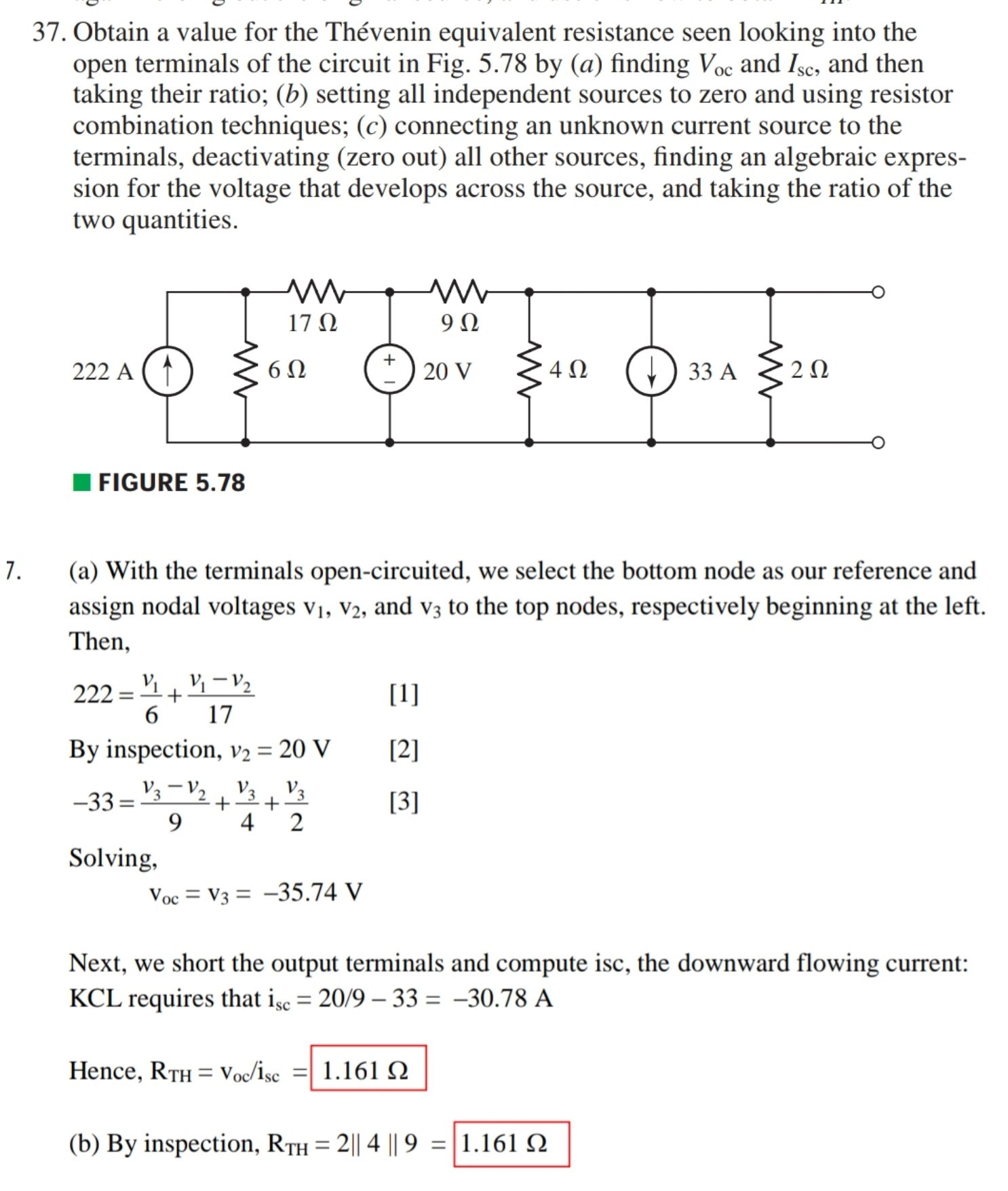
37. Obtain a value for the Thévenin equivalent resistance seen looking into the open terminals of the circuit in Fig. 5.78 by (a) finding \( V_{\mathrm{oc}} \) and \( I_{\mathrm{sc}} \), and then taking their ratio; \( (b) \) setting all independent sources to zero and using resistor combination techniques; \( (c) \) connecting an unknown current source to the terminals, deactivating (zero out) all other sources, finding an algebraic expression for the voltage that develops across the source, and taking the ratio of the two quantities.
FIGURE 5.78
7. (a) With the terminals open-circuited, we select the bottom node as our reference and assign nodal voltages \( \mathrm{v}_{1}, \mathrm{v}_{2} \), and \( \mathrm{v}_{3} \) to the top nodes, respectively beginning at the left. Then,
\[
222=\frac{v_{1}}{6}+\frac{v_{1}-v_{2}}{17}
\]
By inspection, \( v_{2}=20 \mathrm{~V} \)
\[
-33=\frac{v_{3}-v_{2}}{9}+\frac{v_{3}}{4}+\frac{v_{3}}{2}
\]
Solving,
\[
\mathrm{v}_{\mathrm{oc}}=\mathrm{v}_{3}=-35.74 \mathrm{~V}
\]
Next, we short the output terminals and compute isc, the downward flowing current: KCL requires that \( \mathrm{i}_{\mathrm{sc}}=20 / 9-33=-30.78 \mathrm{~A} \)
Hence, \( \mathrm{R}_{\mathrm{TH}}=\mathrm{v}_{\mathrm{oc}} / \mathrm{i}_{\mathrm{sc}}=1.161 \Omega \)
(b) By inspection, \( \mathrm{R}_{\mathrm{TH}}=2\|4\| 9=1.161 \Omega \)