Ace - AI Tutor
Ask Our Educators
Textbooks
My Library
Flashcards
Scribe - AI Notes
Notes & Exams
Download App
Daniela Paez

Daniela P.

Divider

Viewed Questions

The average osmotic pressure of human blood versus water is 7.60 atm . at a temperature of $T=310 . \mathrm{K}$. Calculate the total solute concentration in human blood.

Physical Chemistry for the Life Sciences

Ideal and Real Solutions

Problems

Because of problems associated with oxygen toxicity, nitrogen narcosis, and decompression sickness, the maximum safe limit depth for divers breathing air is 61 m . Calculate the pressure on a diver at this depth. Assuming air is about $20 \%$ oxygen and $80 \%$ nitrogen, calculate the levels of oxygen and nitrogen in the blood at 61 m . Assume Henry's law behavior. Assume $T=298 \mathrm{~K}$.

Physical Chemistry for the Life Sciences

Ideal and Real Solutions

Problems

The concentrations in moles per kilogram of water for the dominant salts in sea water are: $$ \begin{array}{|c|c|c|c|c|c|} \hline \text { Ion } & \mathbf{C l}^{-} & \mathrm{Na}^{+} & \mathrm{Mg}^{2+} & \mathrm{SO}_4^{2-} & \mathrm{Ca}^{2+} \\ \hline \mathrm{Mol} \mathrm{kg}^{-1} & 0.546 & 0.456 & 0.053 & 0.028 & 0.010 \\ \hline \end{array} $$ Calculate the osmotic pressure exerted by sea water at $T=$ 298 K . Suppose sea water is separated from pure water by a membrane that is permeable to water but impermeable to the ions in sea water. Assuming the density of sea water is about equal to pure water at $T=298 \mathrm{~K}$, calculate the column of sea water that would be supported by osmotic pressure.

Physical Chemistry for the Life Sciences

Ideal and Real Solutions

Problems

The vapor pressure of liquid $\mathrm{SO}_2$ is 2232 Pa at 201 K , and $\Delta H_{\text {veparisation }}=24.94 \mathrm{~kJ} \mathrm{~mol}^{-1}$. Calculate the normal and standard boiling points. Does your result for the normal boiling point agree with that in Table 7.1? If not, suggest a possible cause.

Physical Chemistry for the Life Sciences

Phase Equilibria

Problems

Questions asked

ANSWERED

Anand Jangid verified

Numerade educator

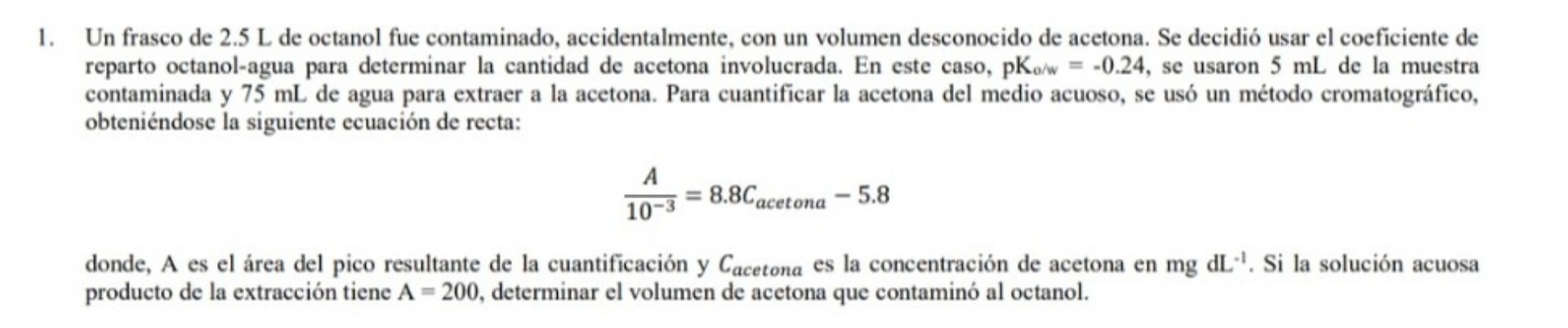
1. Un frasco de 2.5 L de octanol fue contaminado, accidentalmente, con un volumen desconocido de acetona. Se decidi贸 usar el coeficiente de reparto octanol-agua para determinar la cantidad de acetona involucrada. En este caso, pKo/w = -0.24, se usaron 5 mL de la muestra contaminada y 75 mL de agua para extraer a la acetona. Para cuantificar la acetona del medio acuoso, se us贸 un m茅todo cromatogr谩fico, obteni茅ndose la siguiente ecuaci贸n de recta: (A / 10^-3) = 8.8C_acetona - 5.8 donde, A es el 谩rea del pico resultante de la cuantificaci贸n y C_acetona es la concentraci贸n de acetona en mg dL^-1. Si la soluci贸n acuosa producto de la extracci贸n tiene A = 200, determinar el volumen de acetona que contamin贸 al octanol.

View Answer
divider