5. [-/5 Points]
DETAILS
LARCALC11M 13.10.005.
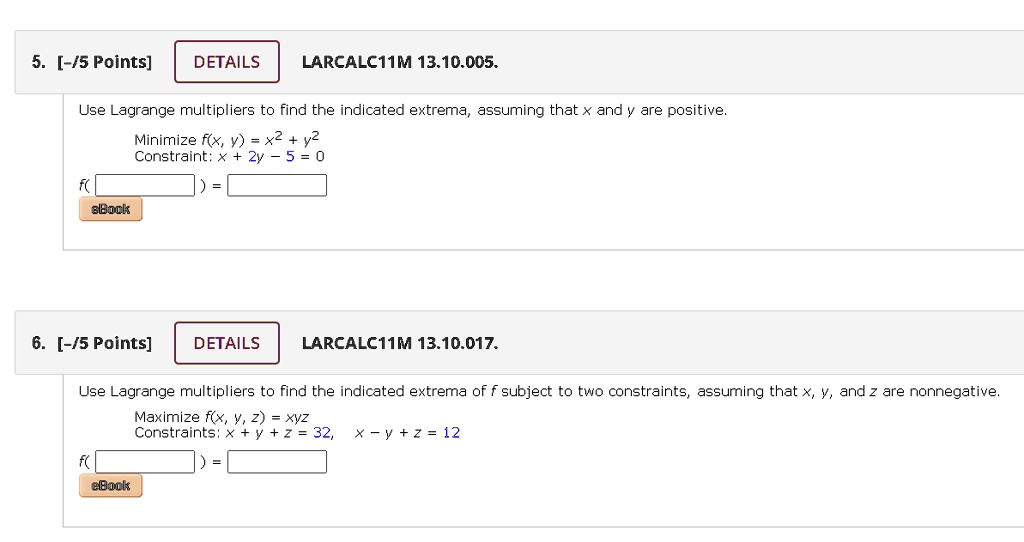
Use Lagrange multipliers to find the indicated extrema, assuming that \(x\) and \(y\) are positive.
Minimize \(f(x, y) = x^2 + y^2\)
Constraint: \(x + 2y - 5 = 0\)
f(\(
6. [-/5 Points]
DETAILS
LARCALC11M 13.10.017.
Use Lagrange multipliers to find the indicated extrema of \(f\) subject to two constraints, assuming that \(x\), \(y\), and \(z\) are nonnegative.
Maximize \(f(x, y, z) = xyz\)
Constraints: \(x + y + z = 32\), \(x - y + z = 12\)
f(\(