68
The First Law of Thermodynamics
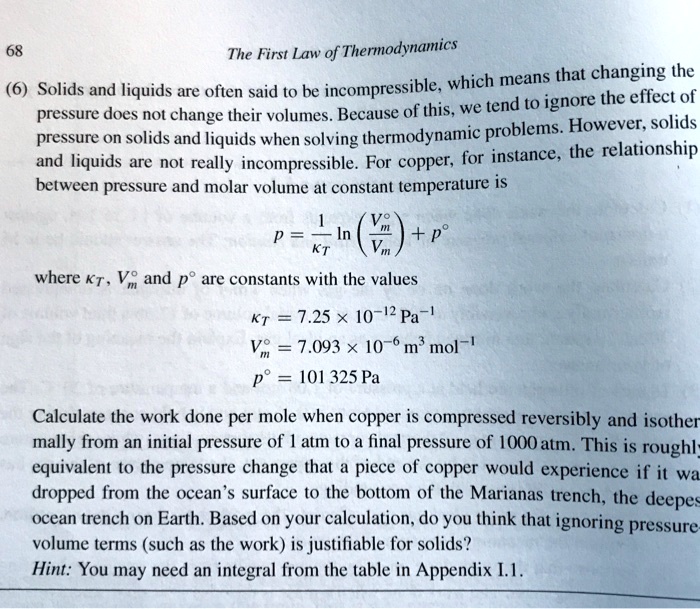
(6) Solids and liquids are often said to be incompressible, which means that changing the
pressure does not change their volumes. Because of this, we tend to ignore the effect of
pressure on solids and liquids when solving thermodynamic problems. However, solids
and liquids are not really incompressible. For copper, for instance, the relationship
between pressure and molar volume at constant temperature is
p = \frac{1}{\kappa_T} \ln \left(\frac{V_m^o}{V_m}\right) + p^o
where $\kappa_T$, $V_m^o$ and $p^o$ are constants with the values
$\kappa_T = 7.25 \times 10^{-12} \text{Pa}^{-1}$
$V_m^o = 7.093 \times 10^{-6} \text{m}^3 \text{mol}^{-1}$
$p^o = 101\ 325 \text{Pa}$
Calculate the work done per mole when copper is compressed reversibly and isother
mally from an initial pressure of 1 atm to a final pressure of 1000 atm. This is roughly
equivalent to the pressure change that a piece of copper would experience if it was
dropped from the ocean's surface to the bottom of the Marianas trench, the deepest
ocean trench on Earth. Based on your calculation, do you think that ignoring pressure-
volume terms (such as the work) is justifiable for solids?
Hint: You may need an integral from the table in Appendix I.1.