Could someone please help me answer these questions with information/details as to why those answers would be correct?
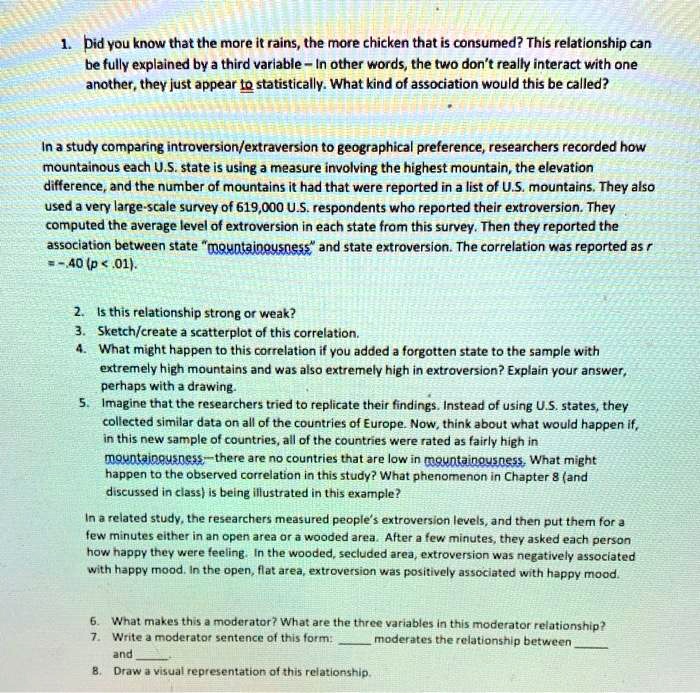
10. Did you know that the more it rains, the more chicken that is consumed? This relationship can be fully explained by a third variable. In other words, the two don't really interact with one another, they just appear to statistically. What kind of association would this be called?
In a study comparing introversion/extraversion to geographical preference, researchers recorded how mountainous each U.S. state is using a measure involving the highest mountain, the elevation difference, and the number of mountains it had that were reported in a list of U.S. mountains. They also used a very large-scale survey of 619,000 U.S. respondents who reported their extroversion. They computed the average level of extroversion in each state from this survey. Then they reported the association between "state mountainousness" and state extroversion. The correlation was reported as r = -0.40, p < 0.01.
2. Is this relationship strong or weak?
3. Sketch/create a scatterplot of this correlation.
4. What might happen to this correlation if you added a forgotten state to the sample with extremely high mountains and was also extremely high in extroversion? Explain your answer, perhaps with a drawing.
5. Imagine that the researchers tried to replicate their findings. Instead of using U.S. states, they collected similar data on all of the countries of Europe. Now, think about what would happen if in this new sample of countries, all of the countries were rated as fairly high in mountainousness - there are no countries that are low in mountainousness. What might happen to the observed correlation in this study? What phenomenon in Chapter 8 (and discussed in class) is being illustrated in this example?
In a related study, the researchers measured people's extroversion levels and then put them for a few minutes either in an open area or a wooded area. After a few minutes, they asked each person how happy they were feeling. In the wooded, secluded area, extroversion was negatively associated with happy mood. In the open, flat area, extroversion was positively associated with happy mood.
6. What makes this a moderator?
7. What are the three variables in this moderator relationship?
8. Write a moderator sentence of this form: [Variable] moderates the relationship between [Variable] and [Variable].
9. Draw a visual representation of this relationship.