Question 4
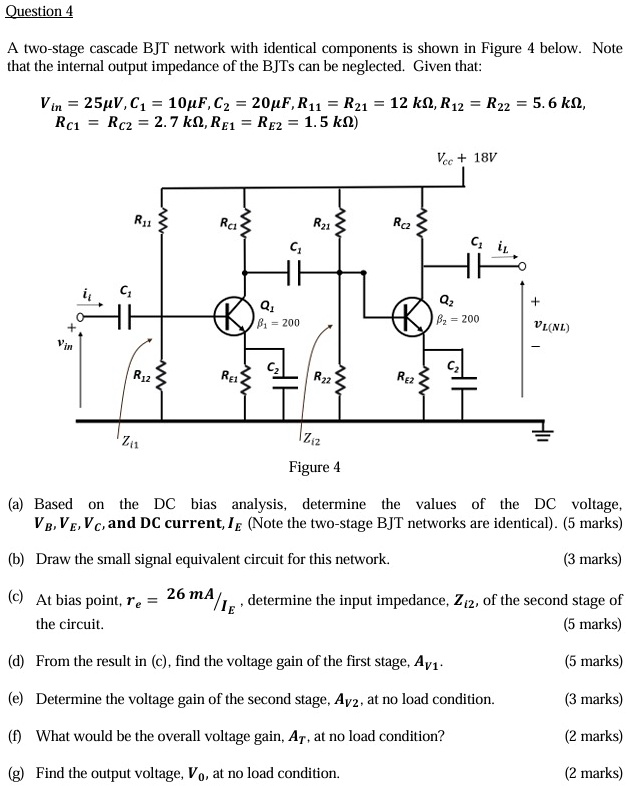
A two-stage cascade BJT network with identical components is shown in Figure 4 below. Note
that the internal output impedance of the BJTs can be neglected. Given that:
$V_{in}$ = 25µV, $C_1$ = 10µF, $C_2$ = 20µF, $R_{11}$ = $R_{21}$ = 12 kΩ, $R_{12}$ = $R_{22}$ = 5.6 kΩ,
$R_{C1}$ = $R_{C2}$ = 2.7 kΩ, $R_{E1}$ = $R_{E2}$ = 1.5 kΩ)
(a) Based on the DC bias analysis, determine the values of the DC voltage,
$V_B$, $V_E$, $V_C$, and DC current, $I_E$ (Note the two-stage BJT networks are identical). (5 marks)
(b) Draw the small signal equivalent circuit for this network. (3 marks)
(c) At bias point, $r_e$ = $\frac{26 mV}{I_E}$, determine the input impedance, $Z_{i2}$, of the second stage of the circuit. (5 marks)
(d) From the result in (c), find the voltage gain of the first stage, $A_{v1}$. (5 marks)
(e) Determine the voltage gain of the second stage, $A_{v2}$, at no load condition. (3 marks)
(f) What would be the overall voltage gain, $A_T$, at no load condition? (2 marks)
(g) Find the output voltage, $V_0$, at no load condition. (2 marks)