Ace - AI Tutor
Ask Our Educators
Textbooks
My Library
Flashcards
Scribe - AI Notes
Notes & Exams
Download App
danielle holmes

danielle h.

Divider

Questions asked

BEST MATCH

Part D $Fe^{3+}$ Express your answer in the order of orbital filling as a string without blank space between orbitals. For example, the electron configuration of Li could be entered as $1s^22s^1$ or $[He]2s^1$. Part E $Cu^+$ Express your answer in the order of orbital filling as a string without blank space between orbitals. For example, the electron configuration of Li could be entered as $1s^22s^1$ or $[He]2s^1$.

View Answer
divider
BEST MATCH

Some time ago a company entered into a forward contract to buy £1.5 million for $1.0 million. The contract now has 6 months to maturity. The daily volatility of a 6-month zero-coupon sterling bond (when its price is translated to dollars) is 0.07% and the daily volatility of a 6-month zero-coupon dollar bond is 0.06%. The correlation between returns from the two bonds is 0.75. The current exchange rate is 1.51. Calculate the standard deviation of the change in the dollar value of the forward contract in 1 day. What is the 20-day 95% VaR? Assume that the 6-month interest rate in both sterling and dollars is 4% per annum with continuous compounding

View Answer
divider
BEST MATCH

Which is NOT one of the ways Kimmerer describes non-human animals? As teachers As rational beings As non human persons As kin

View Answer
divider
BEST MATCH

What is the mole fraction of solute in a 3.79 m aqueous solution? Xsolute =

View Answer
divider
BEST MATCH

QUESTION 2 Which of the following is not an example of a public good? space exploration levees parks a Big Mac

View Answer
divider
BEST MATCH

What is common between the following molecules: HLA-DR, -AK, -ED, and HLA-DQ?

View Answer
divider
BEST MATCH

Write an expression in factored form for the polynomial of least possible degree graphed below.

View Answer
divider
BEST MATCH

ction 7.2 Homework K Question 3, 7.2.11 Part 4 of 6 HW Score: 88.89%, 10.67 of 12 points Points: 0.5 of 1 Determine the total area under the standard normal curve for parts (a) through (c) below. For each, be sure to draw a standard normal curve and shade the area that is to be found. Click here to view the standard normal distribution table (page 1). Click here to view the standard normal distribution table (page 2). (a) Determine the total area under the standard normal curve to the left of $z = -2$ or to the right of $z = 2$. Draw a standard normal curve and shade the area that is to be found. Choose the correct graph below. Click here to view graph c. Click here to view graph a. Click here to view graph d. Click here to view graph b The total area under the standard normal curve to the left of $z = -2$ or to the right of $z = 2$ is 0.0455. (Round to four decimal places as needed.) (b) Determine the total area under the standard normal curve to the left of $z = -1.63$ or to the right of $z = 2.63$. Draw a standard normal curve and shade the area that is to be found. Choose the correct graph below. Click here to view graph a. Click here to view graph b Click here to view graph c. Click here to view graph d. The total area under the standard normal curve to the left of $z = -1.63$ or to the right of $z = 2.63$ is (Round to four decimal places as needed.) w an example Get more help - Q Search Graph b Q 2 Print Done X

View Answer
divider
BEST MATCH

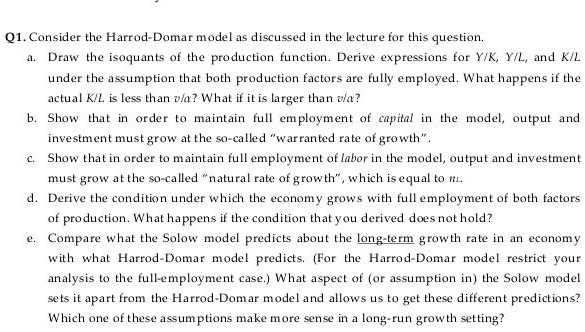
Q1. Consider the Harrod-Domar model as discussed in the lecture for this question. a. Draw the isoquants of the production function. Derive expressions for Y/K, Y/L, and K/L under the assumption that both production factors are fully employed. What happens if the actual K/L is less than $v/a$? What if it is larger than $v/a$? b. Show that in order to maintain full employment of capital in the model, output and investment must grow at the so-called \"warranted rate of growth\" . c. Show that in order to maintain full employment of labor in the model, output and investment must grow at the so-called \"natural rate of growth\", which is equal to $n$. d. Derive the condition under which the economy grows with full employment of both factors of production. What happens if the condition that you derived does not hold? e. Compare what the Solow model predicts about the long-term growth rate in an economy with what Harrod-Domar model predicts. (For the Harrod-Domar model restrict your analysis to the full-employment case.) What aspect of (or assumption in) the Solow model sets it apart from the Harrod-Domar model and allows us to get these different predictions? Which one of these assumptions make more sense in a long-run growth setting?
View Answer
divider
BEST MATCH

10. Solve the following quadratic systems of equations by any method. a. $x^2 + y^2 = 17$ $x - y = 3$ b. $2y - x = 5$ $x^2 + y^2 = 25$ c. $2x^2 - 6y = 10$ $x^2 - y^2 = 1$

View Answer
divider