Ace - AI Tutor
Ask Our Educators
Textbooks
My Library
Flashcards
Scribe - AI Notes
Notes & Exams
Download App
danielle jimenez

danielle j.

Divider

Questions asked

BEST MATCH

Question 9 (2.5 points) Which of the following does not apply to Angiotensin II? It causes vasoconstriction. It is released in response to low blood pressure. Renin causes its release. It is released from the posterior pituitary. It stimulates ADH release. Next Page

View Answer
divider
BEST MATCH

90 percent of the data that exist in the world today was created within the last two years, and by 2025, it's estimated that the global datasphere will grow to 175 zettabytes. But big data analytics is not considered to be that useful, despite the amount of data that is collected. Group of answer choices True False

View Answer
divider
BEST MATCH

Poison ivy explain the steps for treating someone having a reaction to a toxic plant

View Answer
divider
BEST MATCH

Which statement is true of how the justice system views juveniles? Juveniles cannot care for themselves adequately, so they need greater guardianship. Juvenile delinquency represents a breakdown of social mores and requires policy rather than justice. Juvenile incarceration is meant for the juvenile’s safety, adult incarceration for the community’s. Juveniles are at an age when punishments may do the most good, so these should be harsh.

View Answer
divider
BEST MATCH

In the real world, T is not independent of the level of income. Taxes are typically dependent on the level of income, and so tend to be higher when income is higher. Here, we examine how this automatic response of taxes can help reduce the impact of changes in autonomous spending on output. Consider the following model of the economy: C = C0 + C1YD; YD = Y + TR - T T = t0 + t1Y G and I are both constant. a) (5 pts) Is t1 greater or less than 1? Explain. b) (5 pts) Derive the AD equation as a function of autonomous spending and income. What is the slope of the AD line? Solve for the equilibrium output/income using the equilibrium condition. c) (5 pts) What is the multiplier? Does the economy respond more to changes in autonomous spending when t1 is zero or when t1 is positive? Explain. d) (5 pts) Why is fiscal policy in this case called an automatic stabilizer?

View Answer
divider
BEST MATCH

Which of the following is NOT an example of an externality? Cancer-causing chemicals are dumped into the drinking water supply of a city. A cookie company emits a wonderful aroma in the air that makes people smile. The neighbor's wind chimes interfere with your sleep. A firm lays off 100 workers.

View Answer
divider
BEST MATCH

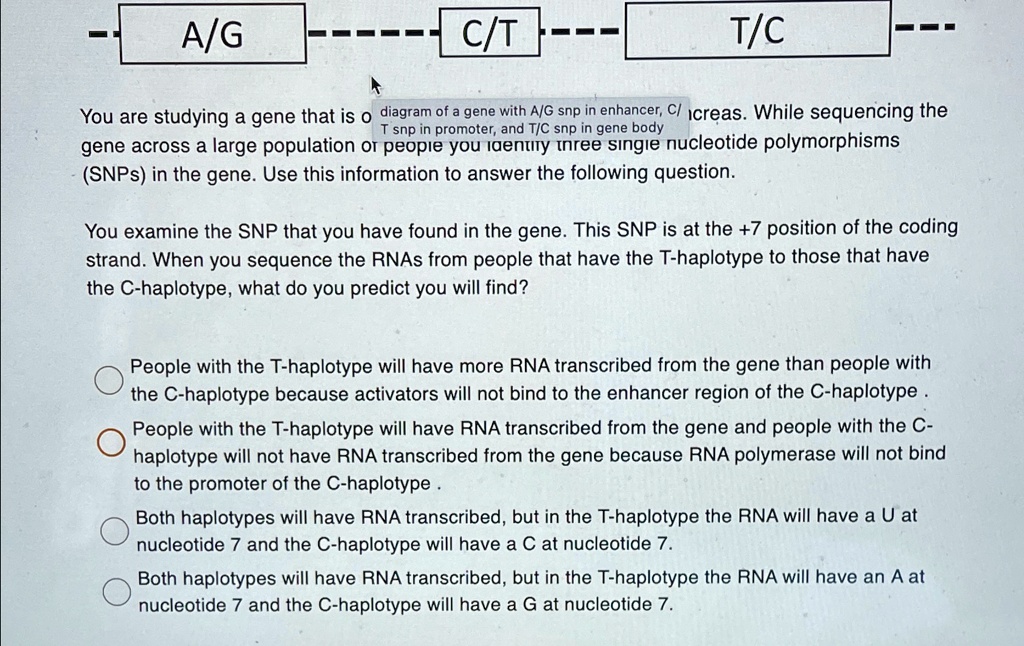
You are studying a gene that is o diagram of a gene with (A)/(G) snp in enhancer, (C)/() Icreas. While sequencing the gene across a large population or people you Iaentiry inree single nucleotide polymorphisms (SNPs) in the gene. Use this information to answer the following question. You examine the SNP that you have found in the gene. This SNP is at the +7 position of the coding strand. When you sequence the RNAs from people that have the T-haplotype to those that have the C-haplotype, what do you predict you will find? People with the T-haplotype will have more RNA transcribed from the gene than people with the C-haplotype because activators will not bind to the enhancer region of the C-haplotype . People with the T-haplotype will have RNA transcribed from the gene and people with the Chaplotype will not have RNA transcribed from the gene because RNA polymerase will not bind to the promoter of the C-haplotype . Both haplotypes will have RNA transcribed, but in the T-haplotype the RNA will have a U at nucleotide 7 and the C-haplotype will have a C at nucleotide 7. Both haplotypes will have RNA transcribed, but in the T-haplotype the RNA will have an A at nucleotide 7 and the C-haplotype will have a G at nucleotide 7. A/G T/C snp in promoter,and T/C snp in gene body (SNPs) in the gene. Use this information to answer the following question. You examine the SNP that you have found in the gene. This SNP is at the +7 position of the coding strand. When you sequence the RNAs from people that have the T-haplotype to those that have the C-haplotype, what do you predict you will find? People with the T-haplotype will have more RNA transcribed from the gene than people with the C-haplotype because activators will not bind to the enhancer region of the C-haplotype . People with the T-haplotype will have RNA transcribed from the gene and people with the C- haplotype will not have RNA transcribed from the gene because RNA polymerase will not bind to the promoter of the C-haplotype. Both haplotypes will have RNA transcribed, but in the T-haplotype the RNA will have a U at nucleotide 7 and the C-haplotype will have a C at nucleotide 7 Both haplotypes will have RNA transcribed, but in the T-haplotype the RNA will have an A at nucleotide 7 and the C-haplotype will have a G at nucleotide 7.
View Answer
divider
BEST MATCH

a) Calculate the area of the shaded part above given a radius of 22cm. b) Calculate the length of BC if OC = 7"

View Answer
divider
BEST MATCH

A relatively thick cantilever beam carry a uniform distributed load of intensity p. Using Timoshenko beam analysis, determine deflection at the free end. Compare and discuss the result with that of the Euler-Bernollie's theorem. The material is isotropic with E as the modulus of elasticity and u as the Poisson's ratio. (Take the shear strain correction factor as 0.8.) (10 Points)

View Answer
divider
BEST MATCH

can be represented in the chemical reaction below: CuS (s) + O (g)- CuO (s) + SO (g) Determine the standard heat of reaction at 25C and at 550C. (20) You are provided with the following information: The heat capacity (Cp) of CuS, O2, CuO, and SO as functions of temperature (T)is given below: CuS:H298=-186.54 KJ/ml Cp=0.05 +1.6x 10⁻³ T -2 104T2 J/(mol-K) O2: Cp=31,1+0.001T-1.5x10⁴T-2J/mol-K CuO:H298=-453.54 KJ/ml Cp=23,2+2.8X10⁻³T-3x10⁻⁵T2J/(mol-K D 32 SOH298=-2923.54 KJ/ml Cp=6.5+0.0095T -25.5x10⁻⁴T-2 J/mol-K)

View Answer
divider