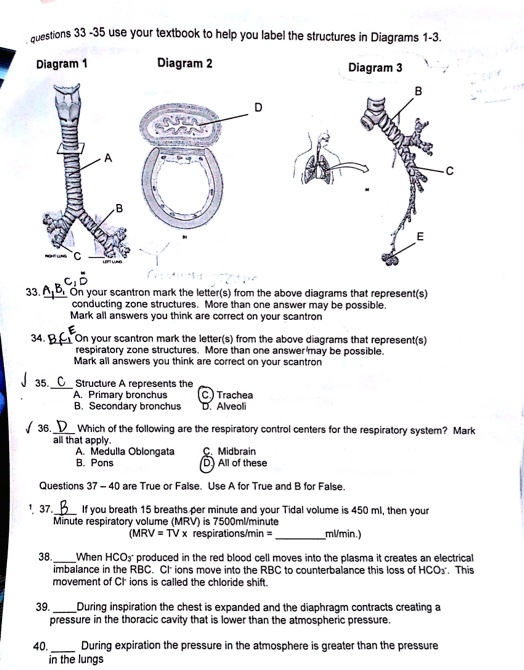
questions 33-35 use your textbook to help you label the structures in Diagrams 1-3.
Diagram 1
Diagram 2
A
B
D
Diagram 3
B
C
E
C
CD
33. A, B, C, D, E On your scantron mark the letter(s) from the above diagrams that represent(s)
conducting zone structures. More than one answer may be possible.
Mark all answers you think are correct on your scantron
34. B, C, E On your scantron mark the letter(s) from the above diagrams that represent(s)
respiratory zone structures. More than one answer may be possible.
Mark all answers you think are correct on your scantron
35. C Structure A represents the
A. Primary bronchus
B. Secondary bronchus
C. Trachea
D. Alveoli
36. Which of the following are the respiratory control centers for the respiratory system? Mark
all that apply.
A. Medulla Oblongata
B. Pons
C. Midbrain
D. All of these
Questions 37-40 are True or False. Use A for True and B for False.
37. B If you breath 15 breaths per minute and your Tidal volume is 450 ml, then your
Minute respiratory volume (MRV) is 7500ml/minute
(MRV = TV x respirations/min = ____ml/min.)
38. When HCO$_3$ produced in the red blood cell moves into the plasma it creates an electrical
imbalance in the RBC. Cl ions move into the RBC to counterbalance this loss of HCO$_3$. This
movement of Cl ions is called the chloride shift.
39. During inspiration the chest is expanded and the diaphragm contracts creating a
pressure in the thoracic cavity that is lower than the atmospheric pressure.
40. During expiration the pressure in the atmosphere is greater than the pressure
in the lungs