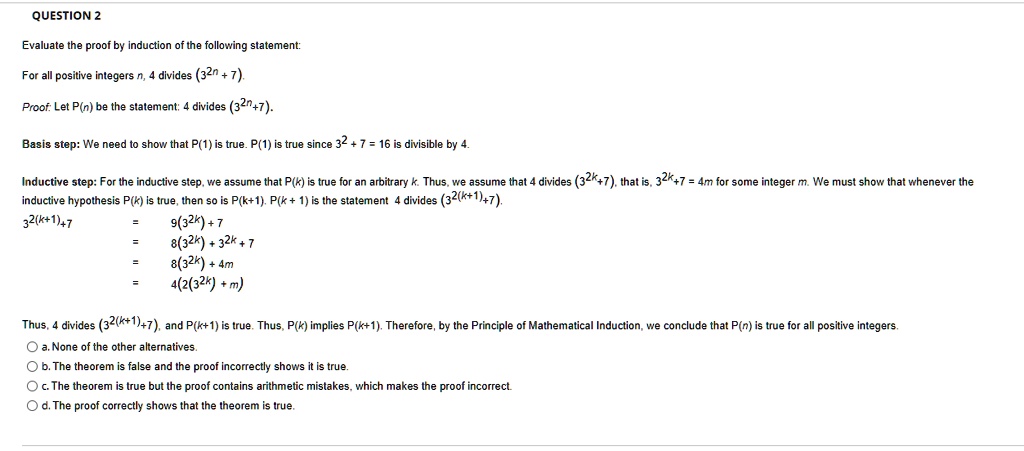
QUESTION 2
Evaluate the proof by induction of the following statement:
For all positive integers $n$, 4 divides ($3^{2n} + 7$).
Proof: Let $P(n)$ be the statement: 4 divides ($3^{2n}+7$).
Basis step: We need to show that $P(1)$ is true. $P(1)$ is true since $3^2 + 7 = 16$ is divisible by 4.
Inductive step: For the inductive step, we assume that $P(k)$ is true for an arbitrary $k$. Thus, we assume that 4 divides ($3^{2k}+7$), that is, $3^{2k}+7 = 4m$ for some integer $m$. We must show that whenever the
inductive hypothesis $P(k)$ is true, then so is $P(k+1)$. $P(k + 1)$ is the statement 4 divides ($3^{2(k+1)}+7$).
$3^{2(k+1)}+7$
$= 9(3^{2k}) + 7$
$= 8(3^{2k}) + 3^{2k} + 7$
$= 8(3^{2k}) + 4m$
$= 4(2(3^{2k}) + m)$
Thus, 4 divides ($3^{2(k+1)}+7$), and $P(k+1)$ is true. Thus, $P(k)$ implies $P(k+1)$. Therefore, by the Principle of Mathematical Induction, we conclude that $P(n)$ is true for all positive integers.
a. None of the other alternatives.
b. The theorem is false and the proof incorrectly shows it is true.
c. The theorem is true but the proof contains arithmetic mistakes, which makes the proof incorrect.
d. The proof correctly shows that the theorem is true.