Pre-Lab:
Experiment 9: Crystal Structures
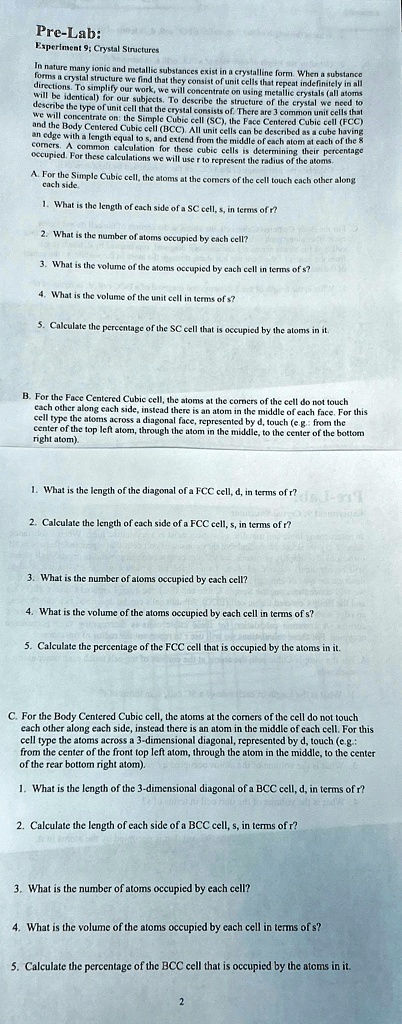
In nature, many ionic and metallic substances exist in a crystalline form. When a substance forms a crystal structure, we find that they consist of unit cells that repeat indefinitely in all directions. To simplify our work, we will concentrate on using metallic crystals (all atoms will be identical) for our subjects. To describe the structure of the crystal, we need to describe the type of unit cell that the crystal consists of. There are 3 common unit cells that we will concentrate on: the Simple Cubic cell (SC), the Face Centered Cubic cell (FCC), and the Body Centered Cubic cell (BCC). All unit cells can be described as a cube having an edge with a length equal to s, and extend from the middle of each atom at each of the 8 corners. A common calculation for these cubic cells is determining their percentage occupied. For these calculations, we will use r to represent the radius of the atoms.
A. For the Simple Cubic cell, the atoms at the corners of the cell touch each other along each side.
1. What is the length of each side of an SC cell, s, in terms of r?
2. What is the number of atoms occupied by each cell?
3. What is the volume of the atoms occupied by each cell in terms of s?
4. What is the volume of the unit cell in terms of s?
5. Calculate the percentage of the SC cell that is occupied by the atoms in it.
B. For the Face Centered Cubic cell, the atoms at the corners of the cell do not touch each other along each side, instead, there is an atom in the middle of each face. For this cell type, the atoms across a diagonal face, represented by d, touch (e.g.: from the center of the top left atom, through the atom in the middle, to the center of the bottom right atom).
6. What is the length of the diagonal of an FCC cell, d, in terms of r?
7. Calculate the length of each side of an FCC cell, s, in terms of r?
8. What is the number of atoms occupied by each cell?
9. What is the volume of the atoms occupied by each cell in terms of s?
10. Calculate the percentage of the FCC cell that is occupied by the atoms in it.
C. For the Body Centered Cubic cell, the atoms at the corners of the cell do not touch each other along each side, instead, there is an atom in the middle of each cell. For this cell type, the atoms across a 3-dimensional diagonal, represented by d, touch (e.g.: from the center of the front top left atom, through the atom in the middle, to the center of the rear bottom right atom).
11. What is the length of the 3-dimensional diagonal of a BCC cell, d, in terms of r?
12. Calculate the length of each side of a BCC cell, s, in terms of r?
13. What is the number of atoms occupied by each cell?
14. What is the volume of the atoms occupied by each cell in terms of s?
15. Calculate the percentage of the BCC cell that is occupied by the atoms in it.