Ace - AI Tutor
Ask Our Educators
Textbooks
My Library
Flashcards
Scribe - AI Notes
Notes & Exams
Download App
dave good

dave g.

Divider

Questions asked

BEST MATCH

a recent survey asked 816 women "how many days in the past seven days have yyou felt sad?"

View Answer
divider
BEST MATCH

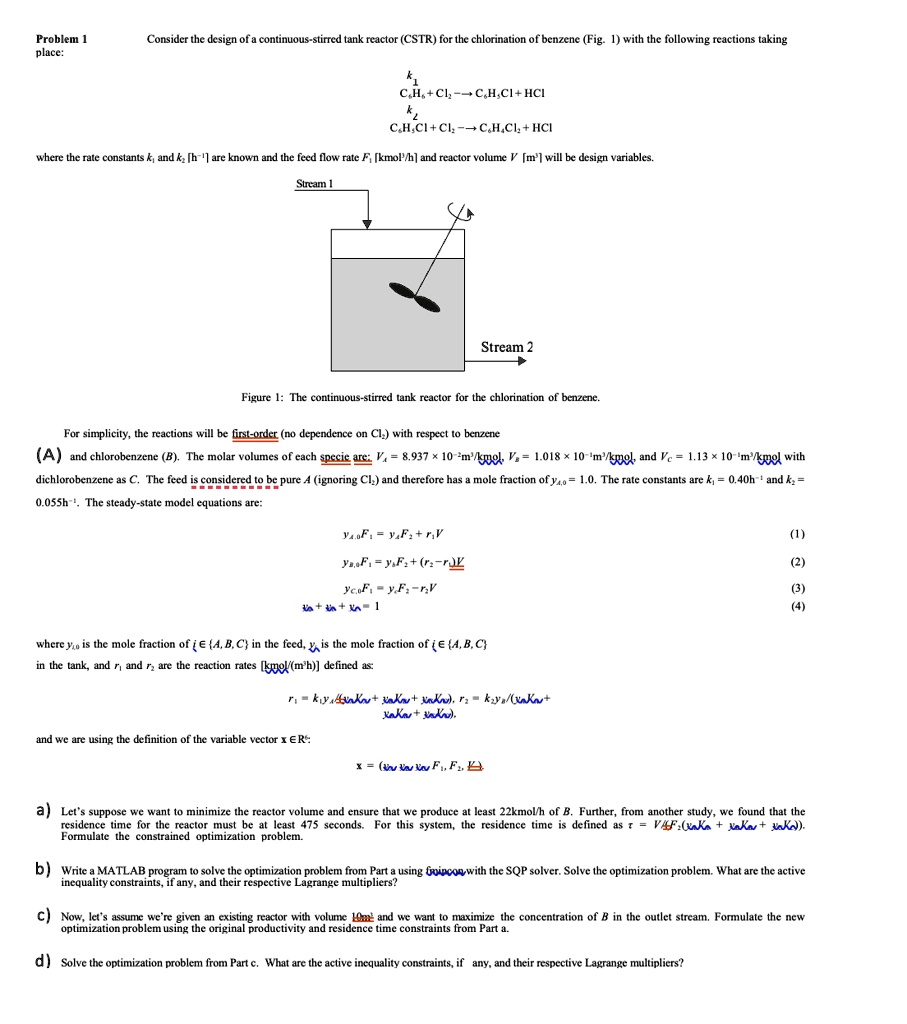
Problem 1 place: Consider the design of a continuous-stirred tank reactor (CSTR) for the chlorination of benzene (Fig. 1) with the following reactions taking place: $$C_6H_6 + Cl_2 \xrightarrow{k_1} C_6H_5Cl + HCl$$ $$C_6H_5Cl + Cl_2 \xrightarrow{k_2} C_6H_4Cl_2 + HCl$$ where the rate constants $k_1$ and $k_2$ [$h^{-1}$] are known and the feed flow rate $F_1$ [kmol/h] and reactor volume $V$ [$m^3$] will be design variables. Figure 1: The continuous-stirred tank reactor for the chlorination of benzene. For simplicity, the reactions will be first-order (no dependence on $Cl_2$) with respect to benzene (A) and chlorobenzene (B). The molar volumes of each specie are: $V_A = 8.937 \times 10^{-2} m^3/kmol$, $V_B = 1.018 \times 10^{-1} m^3/kmol$, and $V_C = 1.13 \times 10^{-1} m^3/kmol$ with dichlorobenzene as C. The feed is considered to be pure A (ignoring $Cl_2$) and therefore has a mole fraction of $y_{A,0} = 1.0$. The rate constants are $k_1 = 0.40 h^{-1}$ and $k_2 = 0.055 h^{-1}$. The steady-state model equations are: $$y_{A,0}F_1 = y_A F_2 + r_1 V \qquad (1)$$ $$y_{B,0}F_1 = y_B F_2 + (r_1 - r_2) V \qquad (2)$$ $$y_{C,0}F_1 = y_C F_2 - r_2 V \qquad (3)$$ $$y_A + y_B + y_C = 1 \qquad (4)$$ where $y_{i,0}$ is the mole fraction of $i \in \{A, B, C\}$ in the feed, $y_i$ is the mole fraction of $i \in \{A, B, C\}$ in the tank, and $r_1$ and $r_2$ are the reaction rates [kmol/($m^3$h)] defined as: $$r_1 = k_1 y_A / (V_A y_A + V_B y_B + V_C y_C), \quad r_2 = k_2 y_B / (V_A y_A + V_B y_B + V_C y_C),$$ and we are using the definition of the variable vector $x \in R^5$: $$x = (y_A, y_B, y_C, F_2, V)$$ a) Let's suppose we want to minimize the reactor volume and ensure that we produce at least 22kmol/h of B. Further, from another study, we found that the residence time for the reactor must be at least 475 seconds. For this system, the residence time is defined as $\tau = V / F_2 = V / (V_A y_A + V_B y_B + V_C y_C)$. Formulate the constrained optimization problem. b) Write a MATLAB program to solve the optimization problem from Part a using fmincon with the SQP solver. Solve the optimization problem. What are the active inequality constraints, if any, and their respective Lagrange multipliers? c) Now, let's assume we're given an existing reactor with volume $10 m^3$ and we want to maximize the concentration of B in the outlet stream. Formulate the new optimization problem using the original productivity and residence time constraints from Part a. d) Solve the optimization problem from Part c. What are the active inequality constraints, if any, and their respective Lagrange multipliers?
View Answer
divider
BEST MATCH

Which of the following correctly compares the factors involved in bulk flow of fluid in systemic and pulmonary capillaries? The brush border of proximal tubule epithelial cells is composed of microvilli found on the basolateral membrane increases the surface area for movement of substances between the tubular fluid and cytosol is composed of microvilli found on the apical membrane increases the surface area for movement of substances between the cytosol and interstitial fluid

View Answer
divider
BEST MATCH

Part 1 of 1- Question 42 of 50 "Animals eating plants" is an integral part of which biogeochemical cycle? A. Carbon cycle B. All of these C. Nitrogen cycle D. Phosphorus cycle Reset Selection 2 Points

View Answer
divider
BEST MATCH

The following equations describe the short-run model: $$ \tilde{Y}_t = a - b(R_t - \tilde{r})$$ $$ \pi_t = \pi_{t-1} + v \tilde{Y}_t + o $$ $$ R_t - r = m(\pi_t - \tilde{\pi})$$ where the parameters are: $a, b, r, v, o, m$ and $\tilde{\pi}$ a. Describe the parameter $a, b, m$ b. Derive the aggregate demand curve. c. Solve for the steady state values of the endogenous variables as a function of the parameters. d. Assume the economy begins in the steady state. The economy experiences an increase in demand for its exports for a number of periods and then demand for exports returns to normal. Describe and show the process of adjusting to the steady state. e. Assume the economy begins in the steady state. The central bank believes the current inflation target $\tilde{\pi}$ is too high and lowers its inflation target to $\pi < \tilde{\pi}$. Describe and show the process of adjusting to the steady state. f. Assume the economy begins in the steady state and price-setters have rational expectations rather than adaptive expectations. The central bank believes the current inflation target $\tilde{\pi}$ is too high and lowers its inflation target to $\pi < \tilde{\pi}$. Describe and show the process of adjusting to the steady state if price-setters believe the central bank will credibly commit to the new inflation target.

View Answer
divider
BEST MATCH

According to the quantity theory of money, the major cause of inflation in the long run is an increase in: the growth rate of real GDP. the standard of living. the velocity of money. the growth rate of the money supply.

View Answer
divider
BEST MATCH

Suppose in a representative sample of adult Americans ages 26 to 32 years. 28% indicated that they owned a fitness band that kept track of the number of steps walked each day and their daily activity levels. Suppose that the sample size was 300. Is there convincing evidence that more than one quarter of all adult Americans in this age group own a fitness band? Test the relevant hypotheses using a significance level of 0.05. State the appropriate null and alternative hypotheses. (Let $p$ = the population proportion of adult Americans ages 26 to 32 years who own a fitness band. Enter for \(x\) as needed.) $H_0$: $H_a$: Find the test statistic. (Round your answer to two decimal places.) Use technology to find the P-value. (Round your answer to four decimal places.) P-value = State the conclusion in the problem context. \(\circ\) Reject $H_0$. We have convincing evidence that more than one-quarter of all adult Americans ages 26 to 32 years own a fitness band. \(\circ\) Reject $H_0$. We do not have convincing evidence that more than one-quarter of all adult Americans ages 26 to 32 years own a fitness band. \(\circ\) Fail to reject $H_0$. We have convincing evidence that more than one-quarter of all adult Americans ages 26 to 32 years own a fitness band. \(\circ\) Fail to reject $H_0$. We do not have convincing evidence that more than one-quarter of all adult Americans ages 26 to 32 years own a fitness band.

View Answer
divider
BEST MATCH

You have performed an enzyme assay and created a lineweaver burk plot by plotting (1/velocity) vs (1/(Substrate Concentration)). The equation that describes the data is a straight line: y = 17x + 10 Determine the maximum velocity ($V_{max}$) to three decimal places.

View Answer
divider
BEST MATCH

Please help. Problem 4: Convert the following Boolean equations into equivalent logic/switching/Boolean circuits (no intermediate work is necessary). Do not perform any optimization of these equations. q + a + y = x Y = ABC + D Problem 5: Write the equation represented by this switching circuit. Do not perform any optimization of the equation. No intermediate work is required. Expression: a + 0 = a a + b = b + a Dual: a1 = a ab = ba P2: P3: P4: a + b + c = a + b + c abc = abc P5: a + bc = a + ba + c ab + c = ab + ac P6: a + a = 1 aa = 0 T1: a + a = a aa = a T2: a + 1 = 1 a0 = 0 T3: a = a T4: a + ab = a aa + b = a T5: a + ab = a + b aa + b = ab T6: ab + ab = a a + ba + b = a + ba + b T7: ab + abc = ab + ac a + ba + b + c = a + ba + c T8: a + b = ab ab = a + b T9: p + p = q + q a + ba + cb + c = a + ba + c T10: f(x1, x2, ..., xn) = xf1, x2, ..., xn + xf0, x2, ..., xn T10(b)

View Answer
divider
BEST MATCH

Vibrations of Particles, Cont. Rotational Vibration of a simple pendulum Given: Pendulum shown Find: Differential equation of vibrations and natural frequency. Assume small angle of rotation. Solution: L m

View Answer
divider