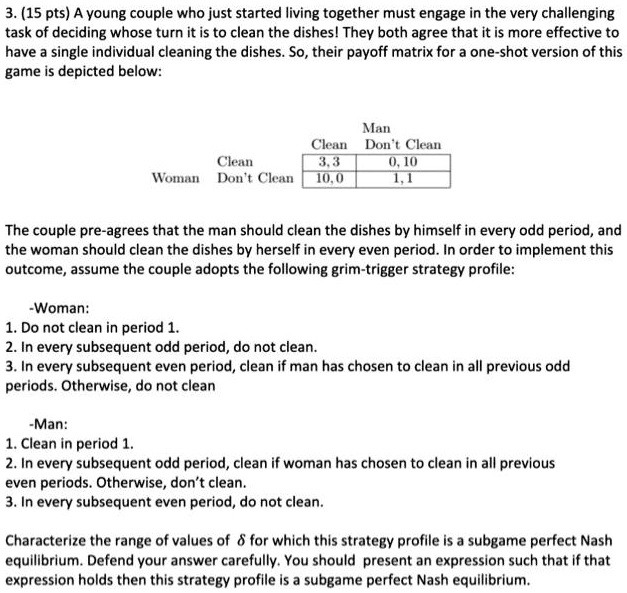
3. (15 pts) A young couple who just started living together must engage in the very challenging task of deciding whose turn it is to clean the dishes! They both agree that it is more effective to have a single individual cleaning the dishes. So, their payoff matrix for a one-shot version of this game is depicted below:
\begin{tabular}{|c|c|c|}
\hline
& \multicolumn{2}{|c|}{Man} \\
\cline{2-3}
Woman & Clean & Don't Clean \\
\hline
Clean & 3, 3 & 0, 10 \\
Don't Clean & 10, 0 & 1, 1 \\
\hline
\end{tabular}
The couple pre-agrees that the man should clean the dishes by himself in every odd period, and the woman should clean the dishes by herself in every even period. In order to implement this outcome, assume the couple adopts the following grim-trigger strategy profile:
-Woman:
1. Do not clean in period 1.
2. In every subsequent odd period, do not clean.
3. In every subsequent even period, clean if man has chosen to clean in all previous odd periods. Otherwise, do not clean
-Man:
1. Clean in period 1.
2. In every subsequent odd period, clean if woman has chosen to clean in all previous even periods. Otherwise, don't clean.
3. In every subsequent even period, do not clean.
Characterize the range of values of $\delta$ for which this strategy profile is a subgame perfect Nash equilibrium. Defend your answer carefully. You should present an expression such that if that expression holds then this strategy profile is a subgame perfect Nash equilibrium.