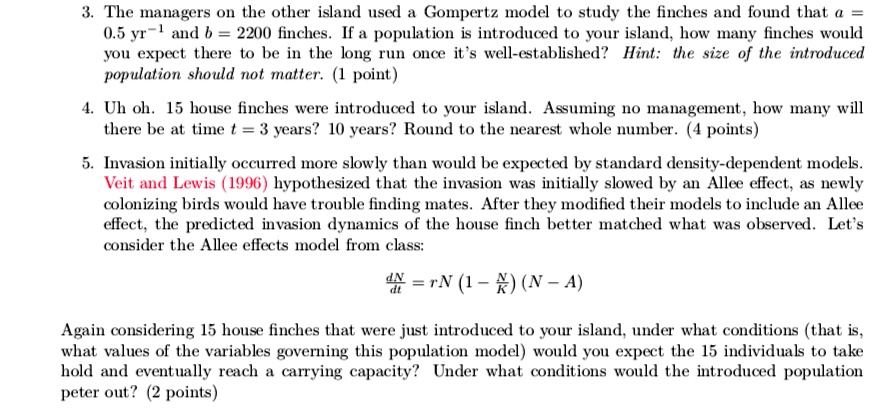
3. The managers on the other island used a Gompertz model to study the finches and found that $a = 0.5\ yr^{-1}$ and $b = 2200$ finches. If a population is introduced to your island, how many finches would you expect there to be in the long run once it's well-established? Hint: the size of the introduced population should not matter. (1 point)
4. Uh oh. 15 house finches were introduced to your island. Assuming no management, how many will there be at time $t = 3$ years? 10 years? Round to the nearest whole number. (4 points)
5. Invasion initially occurred more slowly than would be expected by standard density-dependent models. Veit and Lewis (1996) hypothesized that the invasion was initially slowed by an Allee effect, as newly colonizing birds would have trouble finding mates. After they modified their models to include an Allee effect, the predicted invasion dynamics of the house finch better matched what was observed. Let's consider the Allee effects model from class:
$\frac{dN}{dt} = rN (1 - \frac{N}{K}) (N - A)$
Again considering 15 house finches that were just introduced to your island, under what conditions (that is, what values of the variables governing this population model) would you expect the 15 individuals to take hold and eventually reach a carrying capacity? Under what conditions would the introduced population peter out? (2 points)