CONCEPTUAL
Physics
PRACTICE PAGE
Chapter 4 Newton's Second Law of Motion
Force and Acceleration continued
A
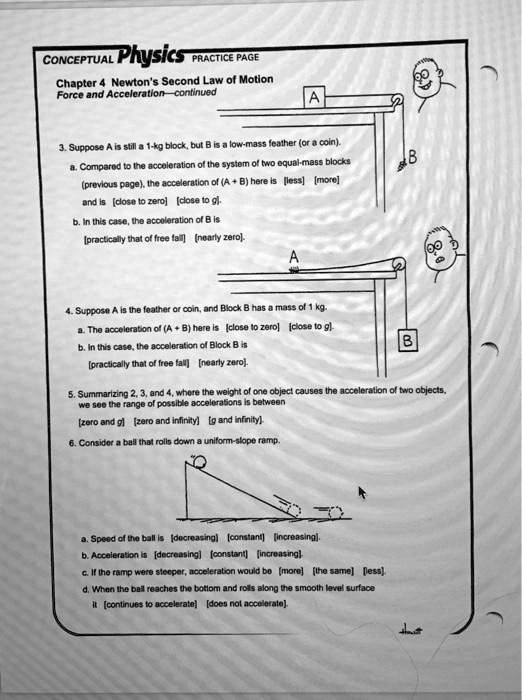
3. Suppose A is still a 1-kg block, but B is a low-mass feather (or a coin).
a. Compared to the acceleration of the system of two equal-mass blocks
(previous page), the acceleration of (A + B) here is [less] [more]
and is [close to zero] [close to g].
b. In this case, the acceleration of B is
[practically that of free fall] [nearly zero).
A
4. Suppose A is the feather or coin, and Block B has a mass of 1 kg.
a. The acceleration of (A + B) here is [close to zero] [close to g].
b. In this case, the acceleration of Block B is
[practically that of free fall] [nearly zero).
B
5. Summarizing 2, 3, and 4, where the weight of one object causes the acceleration of two objects,
we see the range of possible accelerations is between
[zero and g] [zero and infinity] [g and infinity).
6. Consider a ball that rolls down a uniform-slope ramp.
a. Speed of the ball is [decreasing] [constant] [increasing].
b. Acceleration is [decreasing] [constant] [increasing].
c. If the ramp were steeper, acceleration would be [more] [the same] [less].
d. When the ball reaches the bottom and rolls along the smooth level surface
it [continues to accelerate] [does not accelerate).