8. A student determined the mass of her unknown solid (12.04 g), placed it in a glass test tube, hested
the tube in boiling water for several minutes and then carefully transferred the solid into 75.0 g of
water in a coffee cup calorimeter. The temperature of the water increased from 23.2 °C to 24.9 °?.
Assuming all the heat was gained by the water, what is the identity of the solid?
Substance
Specific Heat (J/g-K)
Substance
Specific Heat (J/g-K)
platinum
0.130
titanium
0.590
silver
0.230
aluminum
0.910
a. platinum
b. silver
c. titanium
d. aluminum
9. The specific heat of titanium is 0.590 J/g-K. What is its molar heat capacity?
a. 28.3 J/mol-K
b. 80.1 J/mol-K
c. 1.30 J/mol-K
d. 59.0 J/mol-K
e. 138. J/mol-K
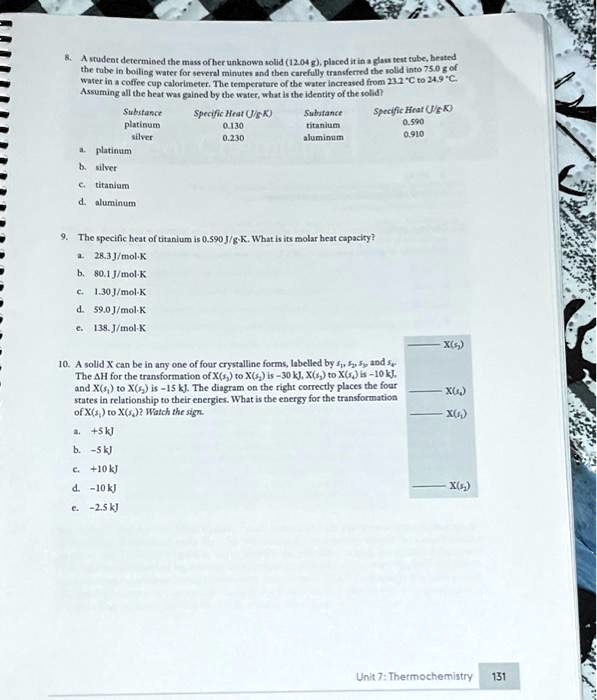
10. A solid X can be in any one of four crystalline forms, labelled by $s_1, s_2, s_3$ and $s_4$.
The $\Delta H$ for the transformation of $X(s_1)$ to $X(s_2)$ is -30 kJ, $X(s_2)$ to $X(s_3)$ is -10 kJ,
and $X(s_3)$ to $X(s_4)$ is -15 kJ. The diagram on the right correctly places the four
states in relationship to their energies. What is the energy for the transformation
of $X(s_1)$ to $X(s_4)$? Watch the sign.
a. +5 kJ
b. -5 kJ
c. +10 kJ
d. -10 kJ
e. -2.5 kJ
$X(s_4)$
$X(s_3)$
$X(s_2)$
$X(s_1)$