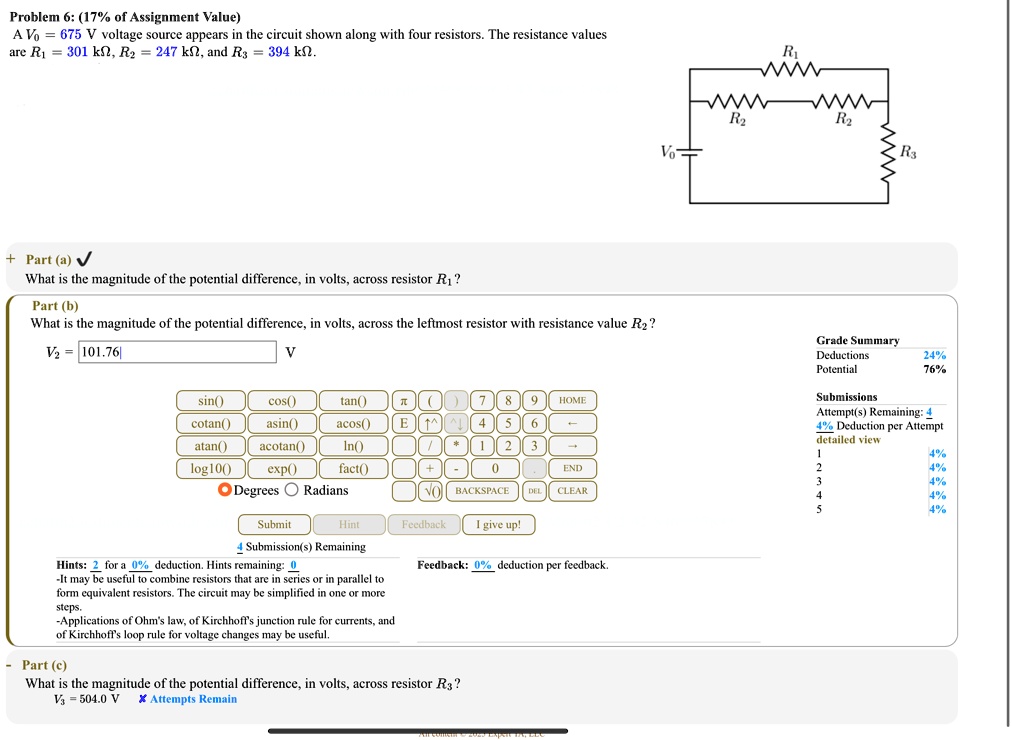
Problem 6: (17% of Assignment Value)
A $V_0 = 675$ V voltage source appears in the circuit shown along with four resistors. The resistance values are $R_1 = 301$ k$\Omega$, $R_2 = 247$ k$\Omega$, and $R_3 = 394$ k$\Omega$.
Part (a)
What is the magnitude of the potential difference, in volts, across resistor $R_1$?
Part (b)
What is the magnitude of the potential difference, in volts, across the leftmost resistor with resistance value $R_2$?
$V_2 = 101.76$ V
Grade Summary
Deductions 24%
Potential 76%
Submissions
Attempt(s) Remaining: 4
4% Deduction per Attempt
detailed view
1 4%
2 4%
3 4%
4 4%
5 4%
Submit Hint Feedback I give up!
4 Submission(s) Remaining
Hints: 2 for a 0% deduction. Hints remaining: 0
-It may be useful to combine resistors that are in series or in parallel to form equivalent resistors. The circuit may be simplified in one or more steps.
-Applications of Ohm's law, of Kirchhoff's junction rule for currents, and of Kirchhoff's loop rule for voltage changes may be useful.
Feedback: 0% deduction per feedback.
Part (c)
What is the magnitude of the potential difference, in volts, across resistor $R_3$?
$V_3 = 504.0$ V
Attempts Remain