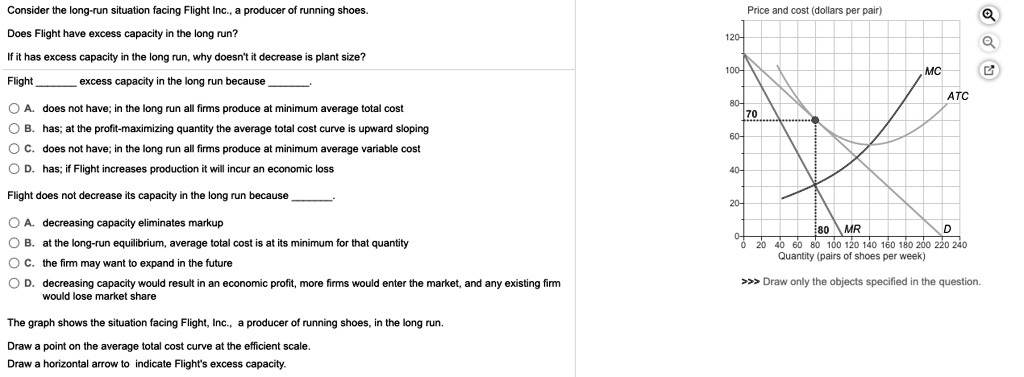
Consider the long-run situation facing Flight Inc., a producer of running shoes.
Does Flight have excess capacity in the long run?
If it has excess capacity in the long run, why doesn't it decrease is plant size?
Flight ______ excess capacity in the long run because ______
A. does not have; in the long run all firms produce at minimum average total cost
B. has; at the profit-maximizing quantity the average total cost curve is upward sloping
C. does not have; in the long run all firms produce at minimum average variable cost
D. has; if Flight increases production it will incur an economic loss
Flight does not decrease its capacity in the long run because ______
A. decreasing capacity eliminates markup
B. at the long-run equilibrium, average total cost is at its minimum for that quantity
C. the firm may want to expand in the future
D. decreasing capacity would result in an economic profit, more firms would enter the market, and any existing firm
would lose market share
The graph shows the situation facing Flight, Inc., a producer of running shoes, in the long run.
Draw a point on the average total cost curve at the efficient scale.
Draw a horizontal arrow to indicate Flight's excess capacity.
120-
100-
Price and cost (dollars per pair)
80-
70
60-
40-
20-
MC
ATC
80 MR
D
0 20 40 60 80 100 120 140 160 180 200 220 240
Quantity (pairs of shoes per week)
>>> Draw only the objects specified in the question.