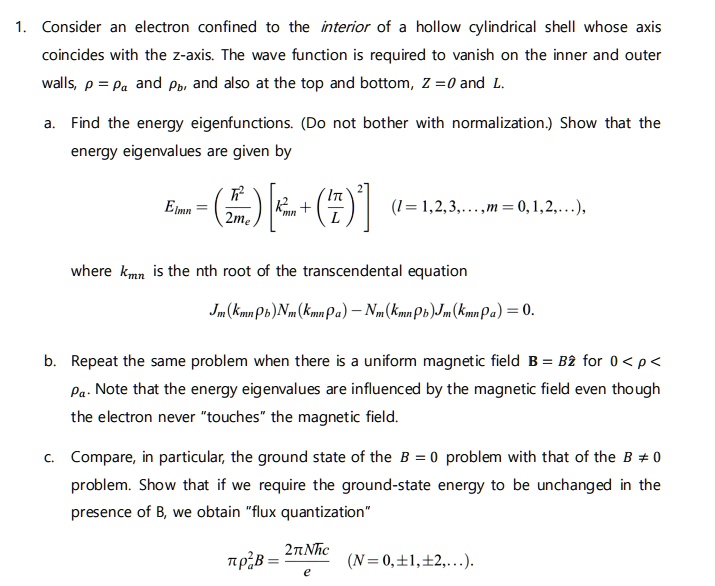
1. Consider an electron confined to the interior of a hollow cylindrical shell whose axis coincides with the z-axis. The wave function is required to vanish on the inner and outer walls, $\rho = \rho_a$ and $\rho_b$, and also at the top and bottom, $z = 0$ and $L$.
a. Find the energy eigenfunctions. (Do not bother with normalization.) Show that the energy eigenvalues are given by
$E_{lmn} = \left(\frac{\hbar^2}{2m_e}\right)\left[k_{mn}^2 + \left(\frac{l\pi}{L}\right)^2\right] \quad (l = 1, 2, 3, \dots, m = 0, 1, 2, \dots),$
where $k_{mn}$ is the nth root of the transcendental equation
$J_m(k_{mn}\rho_b)N_m(k_{mn}\rho_a) - N_m(k_{mn}\rho_b)J_m(k_{mn}\rho_a) = 0$.
b. Repeat the same problem when there is a uniform magnetic field $B = B\hat{z}$ for $0 < \rho < \rho_a$. Note that the energy eigenvalues are influenced by the magnetic field even though the electron never \"touches\" the magnetic field.
c. Compare, in particular, the ground state of the $B = 0$ problem with that of the $B \ne 0$ problem. Show that if we require the ground-state energy to be unchanged in the presence of $B$, we obtain \"flux quantization\"
$\pi \rho_a^2 B = \frac{2\pi N\hbar c}{e} \quad (N = 0, \pm 1, \pm 2, \dots).$