Texts: Note: Please label the answers clearly. (Power System)
THE SOURCE
[The overwhelming majority of power sources are three-phase synchronous generators. Motors, usually Induction Motors, are some of the most common and often the largest loads. Synchronous Motors are also used. (The big change in progress is renewable sources and storage, feeding the system via power electronic dc-ac converters. A second change is the use of dc systems for distribution and utilization, fed by renewables and storage. Microgrids - which have been around forever as co-generation - aggregate some of these into hybrid, ac or dc systems)]
4. A 1 MVA, 3-phase, 4 pole, 60 Hz, 4160V, round-rotor Synchronous generator supplies the induction motor in problem 1.
Generator
Motor
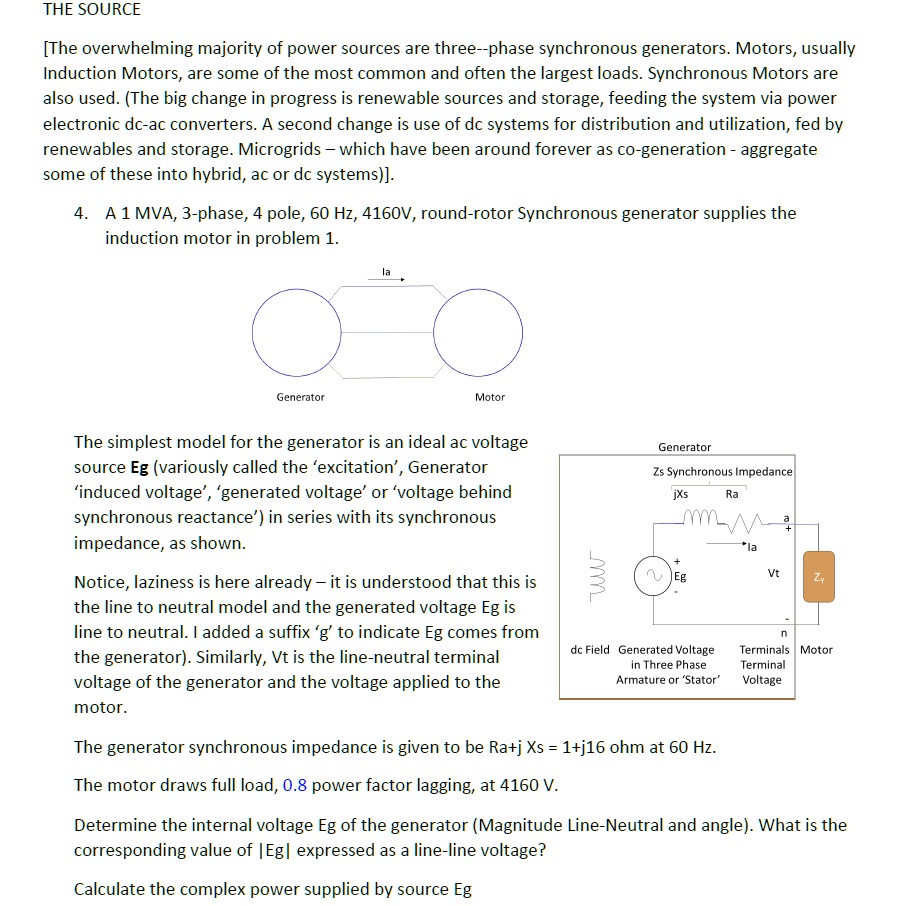
The simplest model for the generator is an ideal ac voltage source Eg (variously called the excitation, Generator
Generator
Zs Synchronous Impedance
induced voltage, generated voltage, or voltage behind
jXs
Ra
synchronous reactance) in series with its synchronous
impedance, as shown.
Notice, laziness is here already -- it is understood that this is the line to neutral model and the generated voltage Eg is line to neutral. I added a suffix 'g' to indicate Eg comes from the generator). Similarly, Vt is the line-neutral terminal
Vt
dc Field Generated Voltage in Three Phase Armature or Stator
Terminals Motor Terminal Voltage
voltage of the generator and the voltage applied to the
motor.
The generator synchronous impedance is given to be Ra + iXs = 1 + i16 ohm at 60 Hz.
The motor draws full load, 0.8 power factor lagging, at 4160 V.
Determine the internal voltage Eg of the generator (Magnitude Line-Neutral and angle). What is the corresponding value of IEgl expressed as a line-line voltage?
Calculate the complex power supplied by source Eg.