Meet the Client: Patty Mills
Patty Mills is a 74-year-old female with a past medical history of coronary artery disease with stent placement, congestive heart failure, hypertension, and diabetes. Fer son brought her to the Emergency Department because she had become increasingly weak and confused and was found by a neighbor wandering her neighborhood unable to locate her home. Patty's son tells the nurse that his mother takes a "water pill" for her blood pressure 2 or 3 times a day. The label on the medication bottle that she brought to the hospital states, "Furosemide (Lasix) 40mg BID". Patty was admitted with a fluid volume deficit.
What other expected assessment findings would you expect on a patient admitted for fluid volume deficit? (List five cues you expect to recognize)
What laboratory results would you expect on this patient? (Bun, Creatinine, Serum Osmolarity, Urine Osmolarity)
As the RN you receive a lab call for a potassium ( Kt ) of 3.0 , What nursing interventions would you initiate? (Generate three solutions)
What type of fluid would the patient receive to help with the fluid volume deficit?
What comorbidity would prompt the nurse to be extra vigilant about monitoring the fluid volume status of this patient? (Clue - part of PMHx; likely reason for furosemide)
What potential complication could occur related to the comorbidity identified in question five and treatment for fluid volume deficit?
The patient has continuous fluids and now exhibits crackles in the lungs, JVD, and edema. Analyzing the cues the RN hypothesizes what complication has occurred?
Based on the RN's hypothesis in question seven, generate solutions. (Generate three solutions a nurse can take action on.)
What patient client teaching would you provide this patient at discharge regarding her furosemide (Lasix) medication if she is restarted on it? (List at least 5 teaching points related to furosemide)
Cite references in APA 7^(th ) edition format.
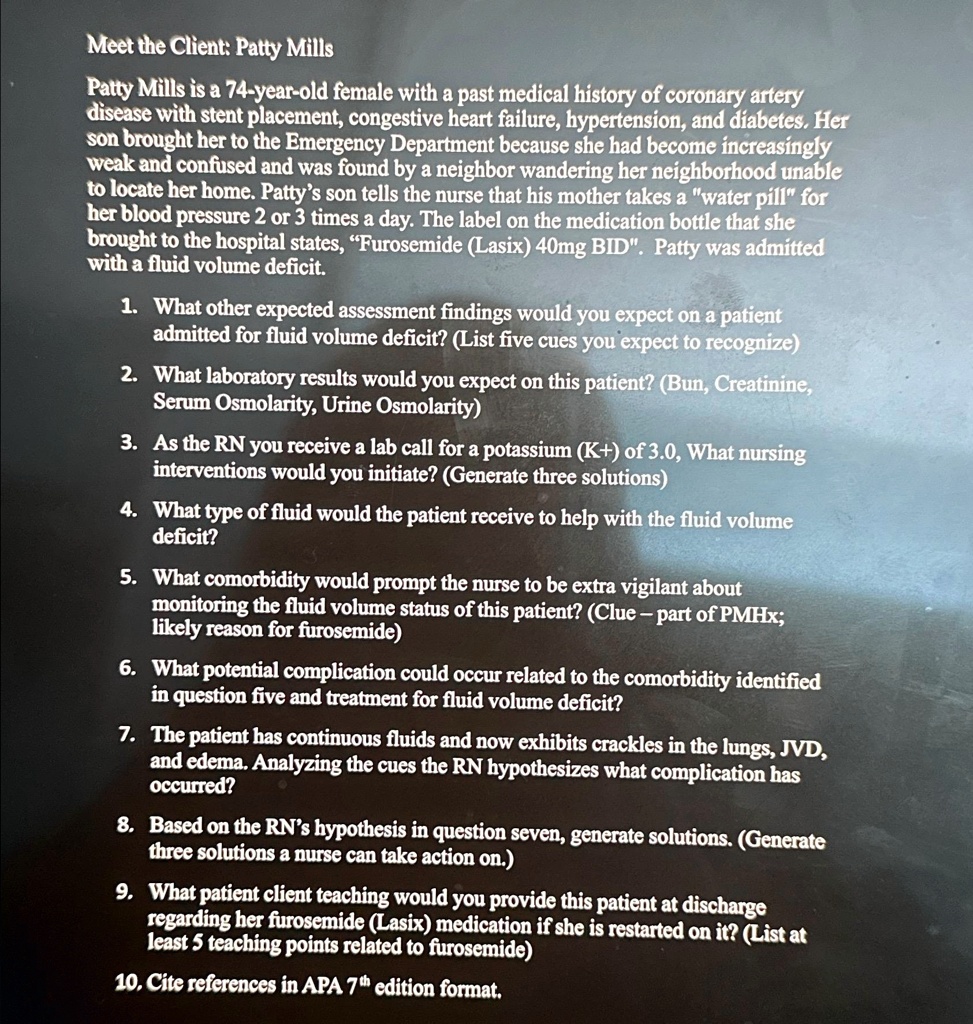
Meet the Client: Patty Mills Patty Mills is a 74-year-old female with a past medical history of coronary artery disease with stent placement, congestive heart failure, hypertension, and diabetes. Her son brought her to the Emergency Department because she had become increasingly weak and confused and was found by a neighbor wandering her neighborhood unable to locate her home. Patty's son tells the nurse that his mother takes a "water pill" for her blood pressure 2 or 3 times a day. The label on the medication bottle that she brought to the hospital states, "Furosemide (Lasix) 40mg BID". Patty was admitted with a fluid volume deficit. 1.What other expected assessment findings would you expect on a patient admitted for fluid volume deficit? (List five cues you expect to recognize) 2.What laboratory results would you expect on this patient? (Bun, Creatinine, Serum Osmolarity, Urine Osmolarity) 3.As the RN you receive a lab call for a potassium (K+) of 3.0, What nursing interventions would you initiate? (Generate three solutions) 4.What type of fluid would the patient receive to help with the fluid volume deficit?
5.What comorbidity would prompt the nurse to be extra vigilant about monitoring the fluid volume status of this patient? (Clue -- part of PMHx; likely reason for furosemide) 6.What potential complication could occur related to the comorbidity identified in question five and treatment for fluid volume deficit? 7.The patient has continuous fluids and now exhibits crackles in the lungs, JVD, and edema. Analyzing the cues the RN hypothesizes what complication has occurred?
8.Based on the RN's hypothesis in question seven, generate solutions. (Generate three solutions a nurse can take action on.) 9.What patient client teaching would you provide this patient at discharge regarding her furosemide (Lasix) medication if she is restarted on it? (List at least 5 teaching points related to furosemide) 10, Cite references in APA 7th edition format.