Ace - AI Tutor
Ask Our Educators
Textbooks
My Library
Flashcards
Scribe - AI Notes
Notes & Exams
Download App
david moody

david m.

Divider

Questions asked

BEST MATCH

Tests were conducted on a 3-kVA, 120/240-V, 50-Hz single-phase transformer and the following results were obtained: Open-circuit test (with 240 V side opened): $V_{oc} = 120 V$, $I_{oc} = 0.505 A$, $P_{oc} = 26 W$ Short-circuit test (with 120 V side shorted): $V_{sc} = 11 V$, $I_{sc} = 8 A$, $P_{sc} = 30 W$ (a) Determine all the parameters of the approximate equivalent circuit of the transformer referred to the 120 V side. (b) Using the approximate equivalent circuit obtained in part 2(a), determine the voltage regulation when the transformer is delivering full load at 0.9272 power factor leading and rated secondary voltage. Use the secondary terminal voltage as the reference. Comment on the performance of the transformer. (c) Find the efficiency of the transformer operated at 75% of full load and 0.8 power factor lagging, with rated secondary terminal voltage. Determine the output KVA corresponding to maximum efficiency as well as the maximum efficiency at 0.8 power factor lagging, with rated secondary voltage. State any assumption made.

View Answer
divider
BEST MATCH

7. ATP is generated as protons (H+) move __their concentration gradient through__ ATP synthase channels and into the mitochondrial matrix.

View Answer
divider
BEST MATCH

A hardware store uses a 28.5\% markup for tools. If a combination wrench set costs the store \$9.94, what is the selling price of the set?

View Answer
divider
BEST MATCH

6. Table C. 2 Page 497 in your text is for identifying the critical value for a t test. For each value of \( N \) given, find the \( d f \). Then, find the value of \( t \) crit for a two-tailed test. \begin{tabular}{|l|l|l|l|} \hline\( \alpha \) & \( \mathrm{N} \) & \( d f \) & tcrit (two-tailed) \( (+/-) \) \\ \hline .05 & 61 & & \\ \hline .05 & 30 & & \\ \hline .05 & 14 & & \\ \hline .01 & 121 & & \\ \hline .01 & 2 & & \\ \hline \end{tabular}

View Answer
divider
BEST MATCH

ELAB QUESTIONS 1. How does "coding DNA" differ from "non-coding DNA"? Coding DNA = codons, non-coding DNA = anticodons 2. Explain the difference between the following DNA markers. a. Minisatellites (VNTRs: variable number of tandem repeats) b. Microsatellites (STRS; short tandem repeats) 3. What is a restriction enzyme? 4. The restriction enzyme Hind III recognizes the DNA sequence between the two adenine nucleotides. How many double stranded DNA fragments would you obtain if you treated the following DNA molecule with Hind III? 3'-CGCCCAAGCTTAACCTAGCAAGCTTCCGGAAGCG 5'-GCGGGTTCGAATTGGATCGTTCGAAGGCCTTCGC 5. How are restriction enzymes useful to bacteria in nature? 6. How do bacteria protect their own DNA from destruction by the restriction enzymes they produce?

View Answer
divider
BEST MATCH

The set of all real numbers of the form a + b√2, where a and b are integers, is a subring of Q[√2]. Why? It is denoted by Z[√2].

View Answer
divider
BEST MATCH

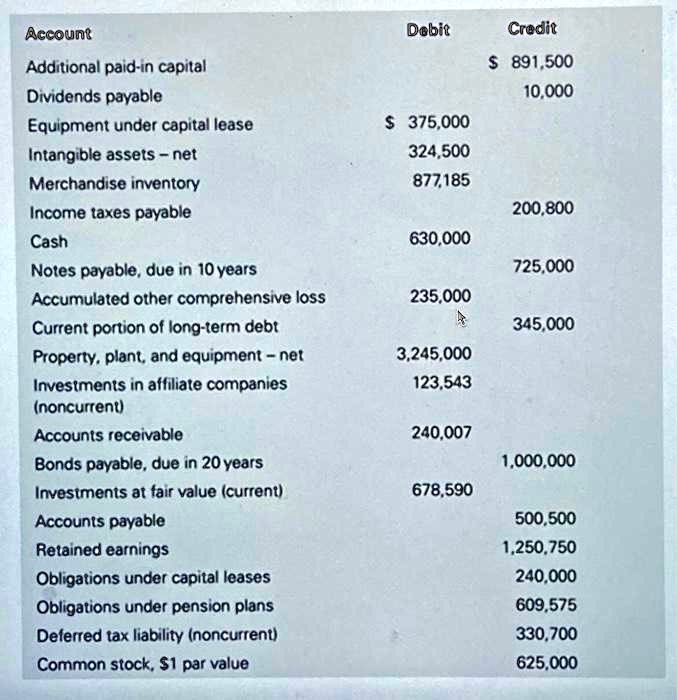
Account Debit Credit Additional paid-in capital $ 891,500 Dividends payable 10,000 Equipment under capital lease $ 375,000 Intangible assets - net 324,500 Merchandise inventory 877,185 Income taxes payable 200,800 Cash 630,000 Notes payable, due in 10 years 725,000 Accumulated other comprehensive loss 235,000 Current portion of long-term debt 345,000 Property, plant, and equipment - net 3,245,000 Investments in affiliate companies 123,543 (noncurrent) Accounts receivable 240,007 Bonds payable, due in 20 years 1,000,000 Investments at fair value (current) 678,590 Accounts payable 500,500 Retained earnings 1,250,750 Obligations under capital leases 240,000 Obligations under pension plans 609,575 Deferred tax liability (noncurrent) 330,700 Common stock, $1 par value 625,000
View Answer
divider
BEST MATCH

Cardiovascular system 21: This valve is between the right ventricle and the artery leading away from the heart. a. aortic semilunar valve b. pulmonary semilunar valve c. bicuspid/mitral valve d. tricuspid e. trick question, there is no valve between these structures Lists: If there is a higher number of leaky calcium ion channels, what would be the overall effect? a. Autorhythmic cells would spontaneously depolarize faster. b. Autorhythmic cells would no longer spontaneously depolarize. c. Autorhythmic cells would not be affected. d. Heart rate would decrease dramatically. e. Voltage-gated sodium channels would open more slowly. 23. End diastolic volume is the: a. residual volume left in the atria after atrial systole. b. residual volume left in the ventricles after ventricular systole. c. maximum volume in the ventricles at the end of atrial systole. d. maximum volume in the ventricles at the end of ventricular systole. e. amount of blood ejected by each ventricle. 24. Injections of potassium chloride are used in lethal injections to stop the heart. Which part of the cardiac action potential is most affected by increasing extracellular potassium levels? a. The plateau phase is greatly reduced. b. Tetanus develops as calcium drops dramatically. c. The initial depolarizing phase occurs at a higher membrane potential. d. The repolarizing phase is prevented. e. All these are affected. 25. The residual or left-over volume in the ventricles after the ventricles have contracted is known as: a. end diastolic volume. b. cardiac output. c. end systolic volume. d. stroke volume. e. all these combined make up this volume. 26. Tetanus is prevented from developing in cardiomyocytes because: (MARK ALL THAT APPLY) a. K ions rush into the cell. b. Na ions rush into the cell. c. Intracellular Ca concentration increases. d. The absolute refractory period is greatly extended. e. The relative refractory period is greatly extended. 27. If voltage-gated calcium ion channels in the membrane of a cardiac muscle cell were blocked, this would cause: a. A much longer cardiac action potential. b. An increase in the length of the plateau phase. c. A decrease in the hyperpolarization period. d. A decrease in the absolute refractory period. e. An increase in the depolarization period.

View Answer
divider
BEST MATCH

List the specific structures that are part of gas exchange in the lungs. Review AaBbCcDdf AaBbCcDdEe AaBbCcDdl AaBbCcDdE Normal Heading1 No Spacing Heading 2 Some of the lower respiratory structures, sections 36.2-36.16, will help. These sections also contain helpful information and videos of lecture material. POST-LAB QUESTIONS - TYPE YOUR ANSWERS INTO THIS DOCUMENT. USE COMPLETE SENTENCES FOR ALL ANSWERS EXCEPT LISTS. PLEASE KEEP THE POINT VALUES WITH THE QUESTIONS, AND THE QUESTIONS WITH YOUR ANSWERS. 1. From proximal to distal, list the specific structures that are part of the conducting zone. (For example - Bronchi is not specific - you need to include types of structures if there is more than one type of something)? 8 points 2. From proximal to distal, list the specific structures that are part of the distribution/respiratory zone? 5 points 3. List the specific structure that is part of gas exchange in the lungs. 2 points 4. Structurally and functionally, why is it that air can be drawn in by EITHER the nose or mouth and still reach the lungs? Use proper terminology to discuss the anatomy of this question. 3.5 points 5. Explain the importance of the rings of cartilage located in the trachea. 3 points 6. Critical Thinking Question (Your textbook contains the information needed to answer this question. Why are they shaped like a C instead of an O as in, why not an O, a B, a Q, etc.? 3 points 7. On the next page that follows, complete the diagram of the pathway of oxygen from the atmosphere to cells by putting the numbered parts in order. 12.5 points 8. On the second page that follows this, complete the diagram of the pathway of carbon dioxide from the cells to the atmosphere by putting the numbered parts in order. 13 points

View Answer
divider
BEST MATCH

The figure below shows a side view of two very large insulating sheets, which pass through x=0 and x=+5 m respectively. They both have uniform surface charge density of equal magnitude $\sigma$ = 57 $\mu$C/m$^2$ and opposite sign. a.) Please find the electric field at each of the following locations: (Note: Earmark this part-- this type of situation is very common!) $\sigma_1$ $\sigma_2$ at x = -8.5 m: $\vec{E}$ = ____ N/C $\hat{i}$ at x = 3.75 m: $\vec{E}$ = ____ N/C $\hat{i}$ at x = 6 m: $\vec{E}$ = ____ N/C $\hat{i}$ If an electron were placed at rest very near the negative plate, how much time would it take to arrive at the positive plate? ____ ns b.) Suppose that plate #2 instead has an identical charge density (including sign) to that of plate #1. Please re-calculate the fields at the locations indicated above. at x = -8.5 m: $\vec{E}$ = ____ N/C $\hat{i}$ at x = 3.75 m: $\vec{E}$ = ____ N/C $\hat{i}$ at x = 6 m: $\vec{E}$ = ____ N/C $\hat{i}$ x=0 +x c.) Suppose that plate #2 is back to negative, but now with TRIPLE the charge density of plate #1. Please re-calculate the fields as above. at x = -8.5 m: $\vec{E}$ = ____ N/C $\hat{i}$ at x = 3.75 m: $\vec{E}$ = ____ N/C $\hat{i}$ at x = 6 m: $\vec{E}$ = ____ N/C $\hat{i}$

View Answer
divider