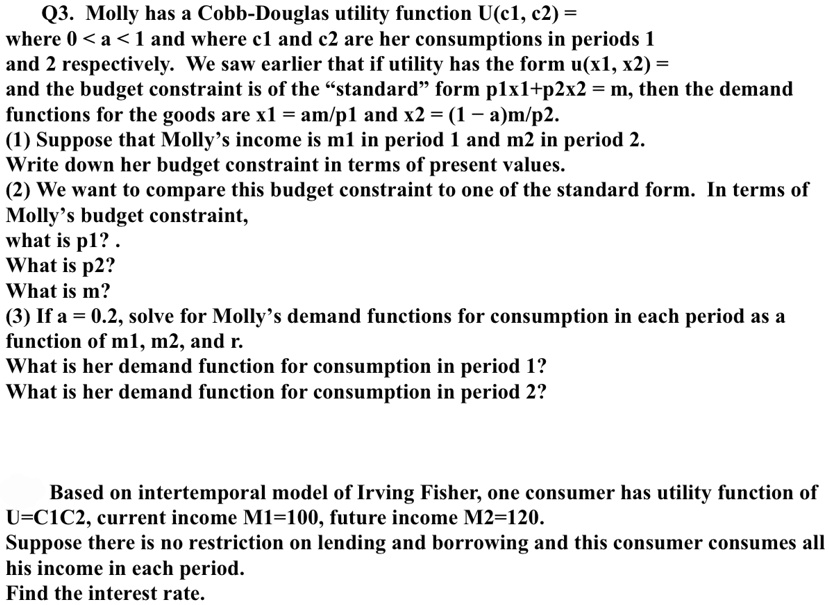
Q3. Molly has a Cobb-Douglas utility function U(c1, c2) =
where 0 < a < 1 and where c1 and c2 are her consumptions in periods 1
and 2 respectively. We saw earlier that if utility has the form u(x1, x2) =
and the budget constraint is of the \"standard\" form p1x1+p2x2 = m, then the demand
functions for the goods are x1 = am/p1 and x2 = (1 - a)m/p2.
(1) Suppose that Molly's income is m1 in period 1 and m2 in period 2.
Write down her budget constraint in terms of present values.
(2) We want to compare this budget constraint to one of the standard form. In terms of
Molly's budget constraint,
what is p1?.
What is p2?
What is m?
(3) If a = 0.2, solve for Molly's demand functions for consumption in each period as a
function of m1, m2, and r.
What is her demand function for consumption in period 1?
What is her demand function for consumption in period 2?
Based on intertemporal model of Irving Fisher, one consumer has utility function of
U=C1C2, current income M1=100, future income M2=120.
Suppose there is no restriction on lending and borrowing and this consumer consumes all
his income in each period.
Find the interest rate.