CHAPTER 5. MAGNETIC SYSTEMS
276
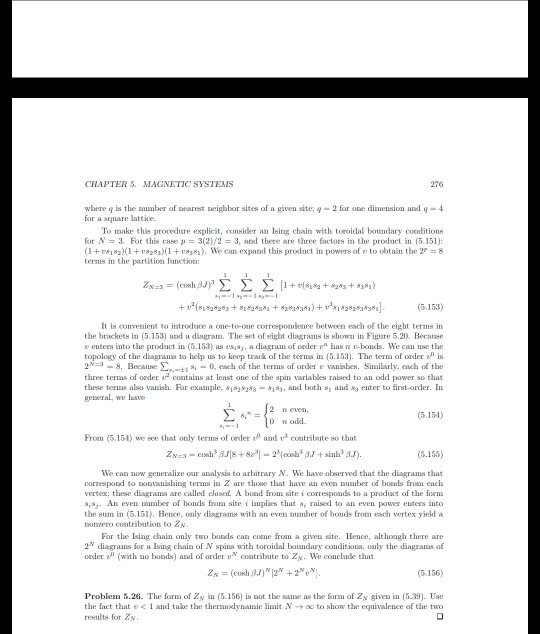
where g is the number of neighbor sites of a given site; q = 2 for one dimension and g = 4 for a square lattice. To make this procedure explicit, consider an Ising chain with toroidal boundary conditions for N = 3. For this case p = 3(2)/2 = 3, and there are three factors in the product in (5.151): g = zaqureqqo ojoswod u1onpod sq pqedxauea1gga+Itgga+1gtga+1 terms in the partition function:
Zx = s = cosh3 [1 + 82 + 8 + 8 + 2(8828283 - 8 + 2881) + 382888].
(5.153)
It is convenient to introduce a one-to-one correspondence between each of the eight terms in the brackets in (5.153) and a diagram. The set of eight diagrams is shown in Figure 5.20. Because enters into the product in (5.153) as us;5, a diagram of order e has n-bonds. We can use the topology of the diagrams to help us keep track of the terms in (5.153). The term of order e3 is three terms of order 2 contains at least one of the spin variables raised to an odd power so that these terms also vanish. For example, s525255 = 553, and both s and s enter to first-order. In general, we have 2n even (5.154) n odd.
From (5.154) we see that only terms of order e and contribute so that Zv = 3 = cosh3.[8 + 82] = 23(cosh3J + sinh3.J (5.155) We can now generalize our analysis to arbitrary N. We have observed that the diagrams that correspond to nonvanishing terms in Z are those that have an even number of bonds from each vertex; these diagrams are called closed. A bond from site i corresponds to a product of the form s,s- An even number of bonds from site i implies that s; raised to an even power enters into the sum in (5.151). Hence, only diagrams with an even number of bonds from each vertex yield a nonzero contribution to Zv. For the Ising chain, only two bonds can come from a given site. Hence, although there are 2 diagrams for an Ising chain of N spins with toroidal boundary conditions, only the diagrams of order e (with no bonds) and of order u contribute to Z. We conclude that Z = (cosh3.) [2 + 2] (5.156)
Problem 5.26. The form of Zy in (5.156) is not the same as the form of Z given in (5.39). Use the fact that e 1 and take the thermodynamic limit N oc to show the equivalence of the two results for Zy.