Questions asked
PRACTICE IT A patient is established with a physician in a primary care practice that provides a team based approach to health care with an emphasis on preventive services, care coordination, and enhanced access for patients. This is known as a(n):
The internal rate of return is the interest rate that causes the net present value to be O negative. O greater than 1. O positive. O zero.
During infancy and childhood, the most important hormonal stimulus of epiphyseal plate activity is __________.
In simple diffusion, a smaller molecule will travel __ than a larger molecule. faster the same as slower
The government establishes a maximum price for water bottles after a natural disaster.What is the effect of this price ceiling on the market? Select the best answer.
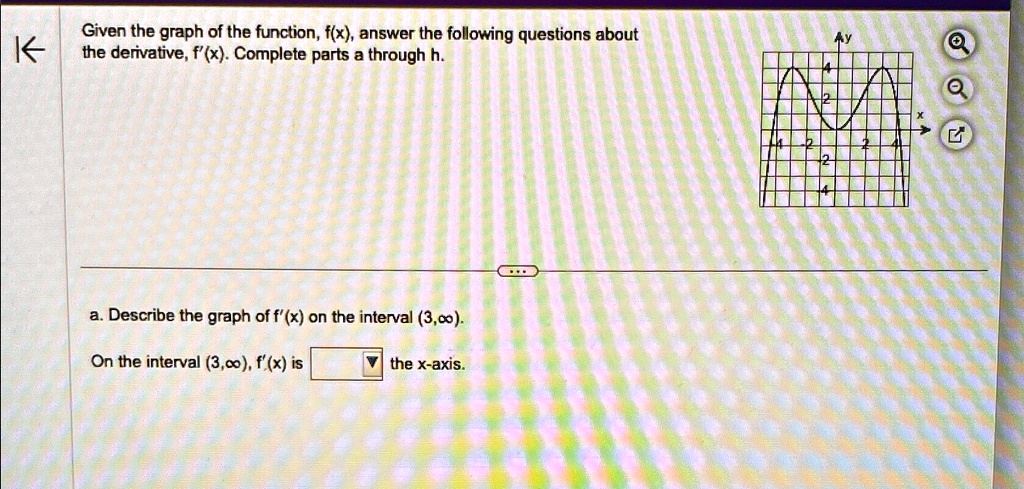
Given the graph of the function, f(x), answer the following questions about the derivative, f'(x). Complete parts a through h. a. Describe the graph of f'(x) on the interval (3,?). On the interval (3,?), f'(x) is the x-axis.
While citrate levels regulate the flux of metabolites through the citric acid cycle in the liver, name the key regulated enzymes of the citric acid cycle in almost all tissues. Predict how they would respond to the low NAD+/NADH ratio and the relative abundance of ATP. (select all that apply) A. Isocitrate dehydrogenase and alpha-ketoglutarate dehydrogenase are the key regulated enzymes in the citric acid cycle. B. Isocitrate dehydrogenase and alpha-ketoglutarate dehydrogenase are activated by a low NAD+/NADH ratio and a relative deficit in ATP level. C. Citrate synthase and isocitrate dehydrogenase are the key regulated enzymes in the citric acid cycle. D. Succinyl-CoA Synthetase and -ketoglutarate dehydrogenase are the key regulated enzymes in the citric acid cycle. E. Citrate synthase and isocitrate dehydrogenase are activated by a low NAD+/NADH ratio and a relative deficit in ATP level.
Consider the differential equation y'' - 6y' + 9y = -2e^{3t}. (a) Find $r_1, r_2$, roots of the characteristic polynomial of the equation above. $r_1, r_2 =$ (b) Find a set of real-valued fundamental solutions to the homogeneous differential equation corresponding to the one above. y_1(t) = y_2(t) = (c) Find a particular solution $y_p$ of the differential equation above. y_p(t) =
Marks 20 The liquid-phase irreversible reaction $A \rightarrow B$ is carried out in a batch reactor. To learn the rate the residence time, t is varied and the effluent concentrations of species A are measured. Pure enters the reactor at a concentration of 7.5 mol/liter in all the runs given below. \begin{tabular}{|c|c|c|c|c|c|c|} \hline t (min) & 0 & 5 & 10 & 20 & 30 & 40 \\ $C_A$ (mol/lit) & 10.00 & 8.10 & 6.40 & 4.55 & 3.25 & 2.40 \\ \hline \end{tabular} a. Set up data analysis table and plot appropriate graph to represent the rate law profile. b. Find the rate constant, k and the order of reaction. (14 Marks (6 Marks)
QUESTION 3 A 100 g glass container contains 250 g of water at 15.0 °C. A 100 g piece of unknown material at 100 °C is added to the water in the container. The final temperature of the mixture is 19.0 °C. What is the specific heat of the unknown material in J/kg °C? (specific heat of water = 4,186 J/kg °C, specific heat of glass = 837.2 J/kg °C) 558 245 387 674