Can you help me solve this?
Can you help me with this?
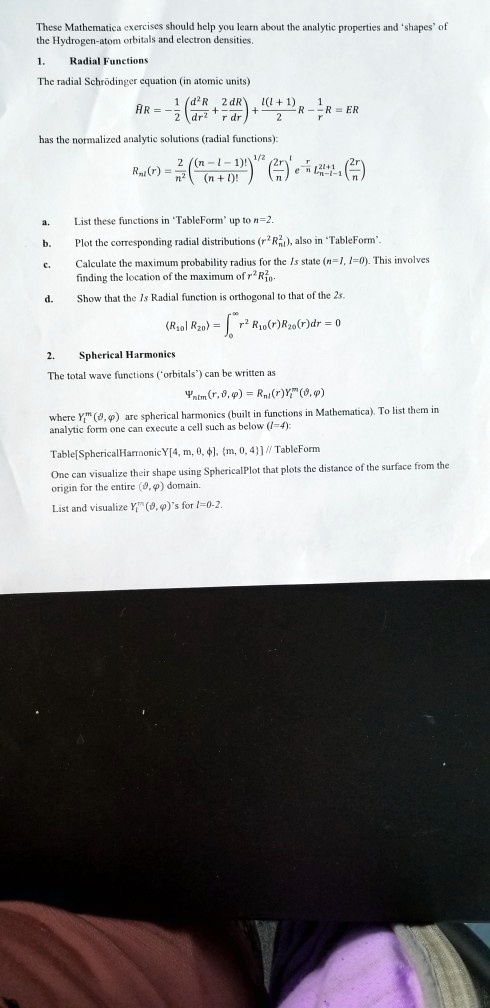
These Mathematica exercises should help you learn about the analytic properties and shapes of the Hydrogen-atom orbitals and electron densities.
1. Radial Functions
The radial Schrödinger equation (in atomic units) has the normalized analytic solutions (radial functions):
a. List these functions in TableForm up to n=2.
b. Plot the corresponding radial distributions (rR), also in TableForm.
c. Calculate the maximum probability radius for the 1s state (n=1, l=0). This involves finding the location of the maximum of r.
d. Show that the 1s Radial function is orthogonal to that of the 2s. ∫r1*R0*r*R1*r^2*dr=0
2. Spherical Harmonics
The total wave functions (orbitals) can be written as Ψ(n,l,m,r,θ,φ) = R(n,l,r) * Y(l,m,θ,φ), where Y are spherical harmonics (built-in functions in Mathematica). To list them in analytic form, one can execute a cell such as the one below (n=4):
Table[SphericalHarmonicY[4, m, 0, θ, φ], {m, 0, 4}] // TableForm
One can visualize their shape using SphericalPlot, which plots the distance of the surface from the origin for the entire (θ, φ) domain. List and visualize Y's for l=0-2.