Functional Analysis
The proof shown here is that CL(X, Y) is a Banach space if and only if Y is a Banach space. Could you help me with the solution to the exercise in detail and explain it to me? Prove that if CL(X,Y) is a Banach space, then Y is a Banach space.
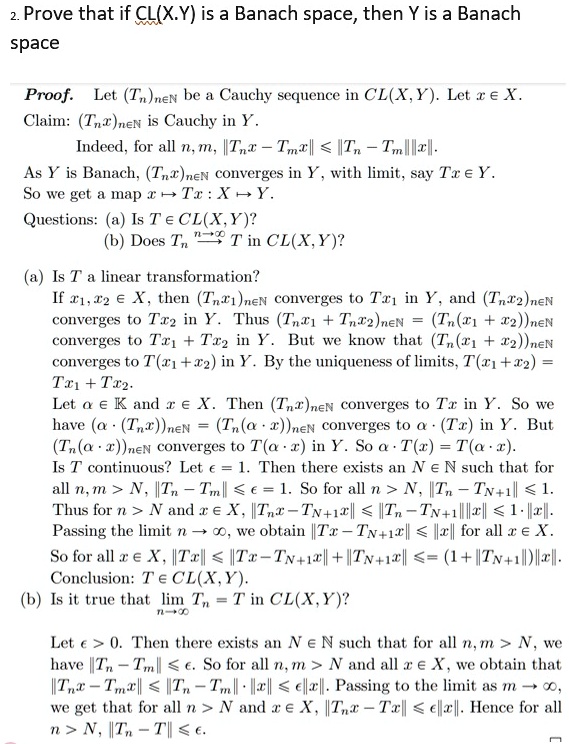
Proof: Let (Tn)_(n in N) be a Cauchy sequence in CL(X, Y). Let x in X.
Claim: (Tn*x)_(n in N) is Cauchy in Y. Indeed, for all n, m, ||Tn*x - Tm*x|| <= ||Tn - Tm|| * ||x||. As Y is Banach, (Tn*x)_(n in N) converges in Y, with limit, say Tx in Y. So we get a map x |-> Tx: x |-> Y.
Questions:
(a) Is T in CL(X, Y)?
(b) Does Tn -> n -> oo T in CL(X, Y)?
(a) Is T a linear transformation? If x1, x2 in X, then (Tn*x1)_(n in N) converges to Tx1 in Y, and (Tn*x2)_(n in N) converges to Tx2 in Y. Thus (Tn*x1 + Tn*x2)_(n in N) = (Tn(x1 + x2))_(n in N) converges to Tx1 + Tx2 in Y. But we know that (Tn(x1 + x2))_(n in N) converges to T(x1 + x2) in Y. By the uniqueness of limits, T(x1 + x2) = Tx1 + Tx2.
Let α in K and x in X. Then (Tn*x)_(n in N) converges to Tx in Y. So we have (α * (Tn*x))_(n in N) = (Tn(α * x))_(n in N) converges to α * (Tx) in Y. But (Tn(α * x))_(n in N) converges to T(α * x) in Y. So α * T(x) = T(α * x).
Is T continuous? Let ε = 1. Then there exists an N in N such that for all n, m > N, ||Tn - Tm|| <= ε = 1. So for all n > N, ||Tn - T(N+1)|| <= 1. Thus for n > N and x in X, ||Tn*x - T(N+1)*x|| <= ||Tn - T(N+1)|| * ||x|| <= 1 * ||x||. Passing the limit n -> ∞, we obtain ||Tx - T(N+1)*x|| <= ||x|| for all x in X. So for all x in X, ||Tx|| <= ||Tx - T(N+1)*x|| + ||T(N+1)*x|| <= (1 + ||T(N+1)||) * ||x||.
Conclusion: T in CL(X, Y).
(b) Is it true that lim (n -> ∞) Tn = T in CL(X, Y)?
Let ε > 0. Then there exists an N in N such that for all n, m > N, we have ||Tn - Tm|| <= ε. So for all n, m > N and all x in X, we obtain that ||Tn*x - Tm*x|| <= ||Tn - Tm|| * ||x|| <= ε * ||x||. Passing to the limit as m -> ∞, we get that for all n > N and x in X, ||Tn*x - Tx|| <= ε * ||x||. Hence for all n > N, ||Tn - T|| <= ε.
Prove that if CL(X, Y) is a Banach space, then Y is a Banach space.
Proof: Let (Tn)_(n in N) be a Cauchy sequence in CL(X, Y). Let x in X.
Claim: (Tn)_(n in N) is Cauchy in Y. Indeed, for all n, m, |Tn*x - Tm*x| < |Tn - Tm| * |x|. As Y is Banach, (Tn)_(n in N) converges in Y, with limit, say Tx in Y. So we get a map x |-> Tx: X -> Y.
Questions:
(a) Is T in CL(X, Y)?
(b) Does Tn - T in CL(X, Y)?
(a) Is T a linear transformation? If 1 in X, then Tn converges to Tx in Y, and Tn converges to Tx in Y. Thus (Tx1 + Txn)_(n in N) = (Tn(x1 + x))_(n in N) converges to Tx1 + Tx2 in Y. But we know that (Tn(x + x))_(n in N) converges to T + in Y. By the uniqueness of limits, T1 + 2 = Tx1 + Tx2. Let α in K and x in X. Then (Tx)_(n in N) converges to Tx in Y. So we have Tx = Tnx)_(n in N) converges to Tx in Y. But Tnx)_(n in N) converges to Tx in Y. So Tx = Tx.
Is T continuous? Let ε = 1. Then there exists an N in N such that for all n, m > N, |Tn - Tm| < ε = 1. So for all n > N, |Tn - TN+1| < 1. Thus for n > N and x in X, |Tnx - TN+1x| < |Tn - TN+1| * |x| < 1 * |x|. Passing the limit n, we obtain |Tx - TN+ < x| for all x in X. So for all x in X, |Tx < |Tx - TN+1x| + |TN+1x| <= 1 + |TN+1|x.
Conclusion: T in CL(X, Y).
Is it true that lim Tn = T in CL(X, Y)?
Let ε > 0. Then there exists an N in N such that for all n, m > N, we have |Tn - Tm| < ε. So for all n, m > N and all x in X, we obtain that |Tx - Tm| < |Tn - Tmx < x. Passing the limit as m, we get that for all n > N and x in X, |Tx - Tx < x. Hence for all n > N, |T - T| < ε.