Pre-Lab Assignment ~ Determining the Ideal Gas Constant
Name____Section #____
1. a) The boiling point temperature of a molecular compound is directly related to the strength of the
attractive forces that the molecules use to adhere to one another. List the three types of inter-
molecular attractive forces.
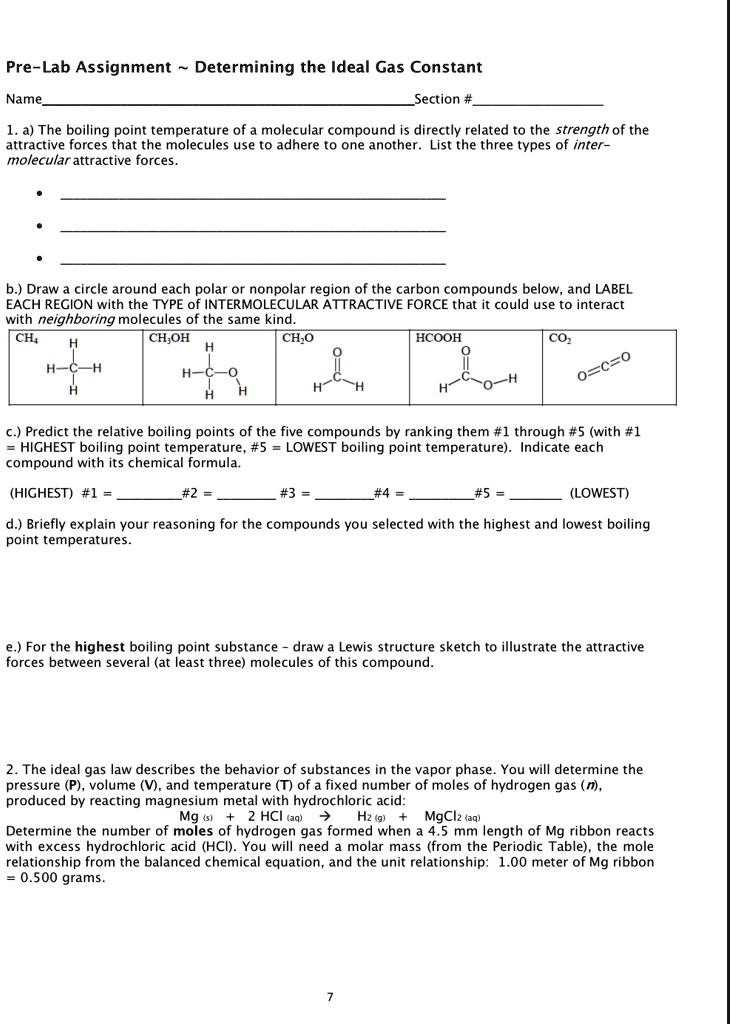
b.) Draw a circle around each polar or nonpolar region of the carbon compounds below, and LABEL
EACH REGION with the TYPE of INTERMOLECULAR ATTRACTIVE FORCE that it could use to interact
with neighboring molecules of the same kind.
$CH_4$
$\qquad H$
$\qquad H-C-H$
$\qquad H$
$CH_3OH$
$\qquad H$
$\qquad H-C-O$
$\qquad H$
$CH_2O$
$\qquad H$
$HCOOH$
$\qquad H-C-O-H$
$CO_2$
$\qquad O=C=O$
c.) Predict the relative boiling points of the five compounds by ranking them #1 through #5 (with #1
= HIGHEST boiling point temperature, #5 = LOWEST boiling point temperature). Indicate each
compound with its chemical formula.
(HIGHEST) #1 =____#2 =____#3 =____#4 =____#5 =____(LOWEST)
d.) Briefly explain your reasoning for the compounds you selected with the highest and lowest boiling
point temperatures.
e.) For the highest boiling point substance - draw a Lewis structure sketch to illustrate the attractive
forces between several (at least three) molecules of this compound.
2. The ideal gas law describes the behavior of substances in the vapor phase. You will determine the
pressure (P), volume (V), and temperature (T) of a fixed number of moles of hydrogen gas ($n$),
produced by reacting magnesium metal with hydrochloric acid:
$Mg_{(s)} + 2 HCl_{(aq)} \rightarrow H_{2(g)} + MgCl_{2(aq)}$
Determine the number of moles of hydrogen gas formed when a 4.5 mm length of Mg ribbon reacts
with excess hydrochloric acid (HCl). You will need a molar mass (from the Periodic Table), the mole
relationship from the balanced chemical equation, and the unit relationship: 1.00 meter of Mg ribbon
= 0.500 grams.
7