Ace - AI Tutor
Ask Our Educators
Textbooks
My Library
Flashcards
Scribe - AI Notes
Notes & Exams
Download App
deborah johnson

deborah j.

Divider

Questions asked

BEST MATCH

Which do you think is more valuable in expressing the relationship between calories and fatlong dash—the covariance or the coefficient of correlation?

View Answer
divider
BEST MATCH

Section 4.3 4. 17 a) Use the node-voltage method to find $v_o$ in the PSPICE MULTISIM circuit in Fig. P4.17. b) Find the power absorbed by the dependent source. c) Find the total power developed by the independent sources. Figure P4.17

View Answer
divider
BEST MATCH

In the Oliver-Rosalki method, the reverse reaction is used to measure CK activity, The enzyme(s) used in the coupling reactions is(are): Select one: a. luciferase b. pyruvate kinase and LD c. hexokinase and G6PD d. adenylase kinase

View Answer
divider
BEST MATCH

Shelby really enjoys bubble gum and chews 10-15 pieces daily. She also really likes drinking coffee and easily drinks 1-2 a day. One morning she finds that coffee is giving her stomach aches. What would you expect to happen to her coffee and bubble gum consumption? Select an answer and submit. For keyboard navigation, use the up/down arrow keys to select an answer. a She will stop drinking as much coffee b She will start drinking slightly less coffee c She will start chewing slightly less gum d She will stop chewing bubble gum. e a & c

View Answer
divider
BEST MATCH

Percy the cat likes to run around a lot. Starting at rest, he accelerates along a straight line to a speed of 12.0 m/s in 3.5 seconds. a) What is Percy's acceleration in m/s2? b) Percy continues to run at 12.0 m/s in a straight line for 9.6 seconds until he sees his food bowl, at which point he skids to a halt over a distance of 11.9 meters. What is his acceleration during the time he skids to a halt? (Remember to include the correct sign + or - on your acceleration.) Report your answer with one decimal place in the box below. Include your work for this part of the problem in your written solution. c) What is Percy's total displacement in meters from when he started running until when he came to a halt? Show your work and report this answer in your written solution. d) Draw sketches of position vs. time and velocity vs. time for Percy's motion. Include these in your written solution.

View Answer
divider
BEST MATCH

If an earthquake is 40 times as intense as a 0-level earthquake, what is the Richter Scale ranking of this earthquake? Round off your answer to one decimal place.

View Answer
divider
BEST MATCH

What protein might be involved in a replication fork collapse in synthesizing DNA in prokaryotes?

View Answer
divider
BEST MATCH

Which statements are correct for opioids? Multiple answers. - Opioid drugs can be used as analgesics. - The three receptors are named mu, beta, and kappa. - Opioids are peptides. - All three receptors are activatory.

View Answer
divider
BEST MATCH

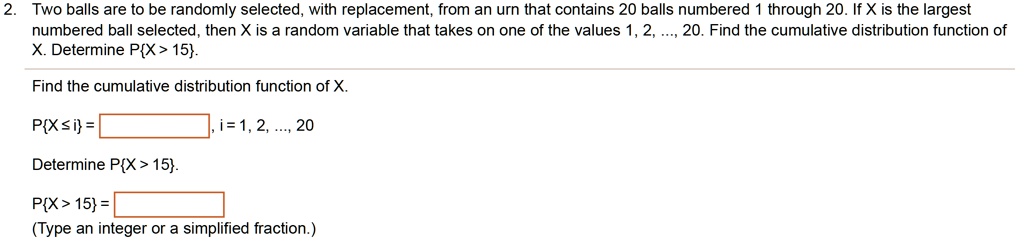
2. Two balls are to be randomly selected, with replacement, from an urn that contains 20 balls numbered 1 through 20. If X is the largest numbered ball selected, then X is a random variable that takes on one of the values 1, 2, ..., 20. Find the cumulative distribution function of X. Determine P{X > 15}. Find the cumulative distribution function of X. P{X ? i} = Determine P{X > 15}. P{X > 15} = i = 1, 2, ..., 20 (Type an integer or a simplified fraction.)
View Answer
divider
BEST MATCH

The following table summarizes data from the last 1000 Uber rides. The response variable is y (which takes a value of 1 if the passenger tipped the driver, 0 otherwise). The target variables are x1 (which takes a value of 1 if the passenger is identified as male, 0 otherwise), and x2 (which takes a value of 1 if it is a night-time ride, 0 if it is a day-time ride). Is passenger male? Is ride night time? Is driver tipped? Total Yes No Yes No x1=1 x1=0 x2=1 x2=0 Tipped (y=1) 700 560 140 630 70 Not Tipped (y=0) 300 240 60 36 264 Total 1000 800 200 666 334 Suppose the next passenger is male and it is a night-time ride. Using naïve Bayes, calculate the odds that the passenger will tip the driver? Note: Odds that the passenger will tip = prob(passenger will tip)/prob(passenger will not tip) 2.333 17.5 7.976 40.83 0.504 0.057 4.2 0.946

View Answer
divider