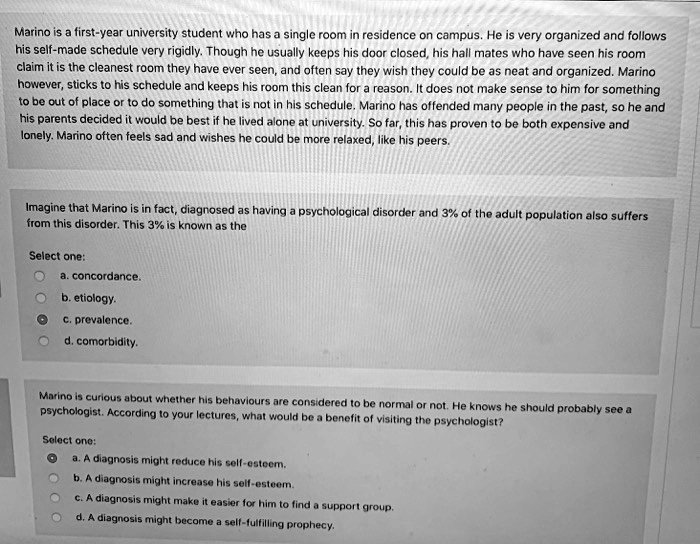
Marino is a first-year university student who has a single room in residence on campus. He is very organized and follows
his self-made schedule very rigidly. Though he usually keeps his door closed, his hall mates who have seen his room
claim it is the cleanest room they have ever seen, and often say they wish they could be as neat and organized. Marino
however, sticks to his schedule and keeps his room this clean for a reason. It does not make sense to him for something
to be out of place or to do something that is not in his schedule. Marino has offended many people in the past, so he and
his parents decided it would be best if he lived alone at university. So far, this has proven to be both expensive and
lonely. Marino often feels sad and wishes he could be more relaxed, like his peers.
Imagine that Marino is in fact, diagnosed as having a psychological disorder and 3% of the adult population also suffers
from this disorder. This 3% is known as the
Select one:
a. concordance.
b. etiology.
c. prevalence.
d. comorbidity.
Marino is curious about whether his behaviours are considered to be normal or not. He knows he should probably see a
psychologist. According to your lectures, what would be a benefit of visiting the psychologist?
Select one:
a. A diagnosis might reduce his self-esteem.
b. A diagnosis might increase his self-esteem.
c. A diagnosis might make it easier for him to find a support group.
d. A diagnosis might become a self-fulfilling prophecy.