Box 3.1 Monsanto’s Roundup
Monsanto’s leading product, Roundup, is the trademarked name of glyphosate, a
chemical herbicide developed and patented by the firm in the 1970s. Roundup
is referred to as a nonselective herbicide, meaning it kills most plants. In the
late 1990s, it became the best-selling agricultural chemical of all time and an
enormously profitable product for Monsanto.
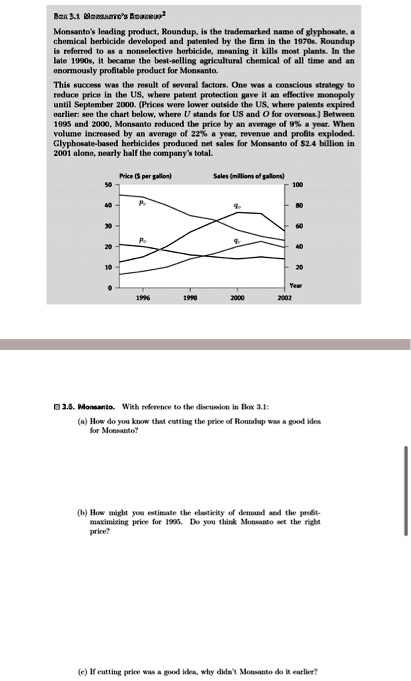
This success was the result of several factors. One was a conscious strategy to
reduce price in the US, where patent protection gave it an effective monopoly
until September 2000. (Prices were lower outside the US, where patents expired
earlier: see the chart below, where U stands for US and O for overseas.) Between
1995 and 2000, Monsanto reduced the price by an average of 9% a year. When
volume increased by an average of 22% a year, revenue and profits exploded.
Glyphosate-based herbicides produced net sales for Monsanto of $2.4 billion in
2001 alone, nearly half the company’s total.
Price ($ per gallon)
Sales (millions of gallons)
50
100
40
80
$P_U$
30
60
$P_O$
40
20
20
10
0
1996
1998
2000
2002
Year
3.6. Monsanto. With reference to the discussion in Box 3.1:
(a) How do you know that cutting the price of Roundup was a good idea
for Monsanto?
(b) How might you estimate the elasticity of demand and the profit-
maximizing price for 1995. Do you think Monsanto set the right
price?
(c) If cutting price was a good idea, why didn’t Monsanto do it earlier?