Problem 5.28. Using the accounting trick described in Section 5.8, what is the
amortized cost of deleting the largest item from a binomial heap?
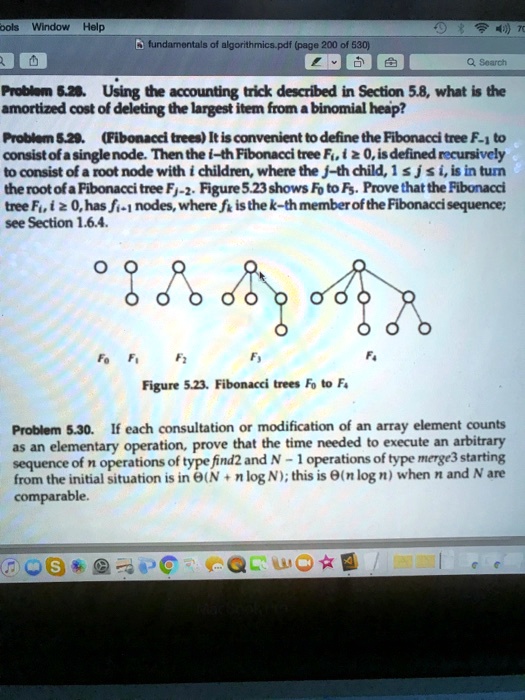
Problem 5.29. (Fibonacci trees) It is convenient to define the Fibonacci tree $F_{i-1}$ to
consist of a single node. Then the $i$-th Fibonacci tree $F_i$, $i \ge 0$, is defined recursively
to consist of a root node with $i$ children, where the $j$-th child, $1 \le j \le i$, is in turn
the root of a Fibonacci tree $F_{j-2}$. Figure 5.23 shows $F_0$ to $F_5$. Prove that the Fibonacci
tree $F_i$, $i \ge 0$, has $f_{i-1}$ nodes, where $f_k$ is the $k$-th member of the Fibonacci sequence;
see Section 1.6.4.
$F_0$ $F_1$ $F_2$ $F_3$ $F_4$ $F_5$
Figure 5.23. Fibonacci trees $F_0$ to $F_5$
Problem 5.30. If each consultation or modification of an array element counts
as an elementary operation, prove that the time needed to execute an arbitrary
sequence of $n$ operations of type find2 and $N$ - 1 operations of type merge3 starting
from the initial situation is in $O(N + n \log N)$; this is $O(n \log n)$ when $n$ and $N$ are
comparable.