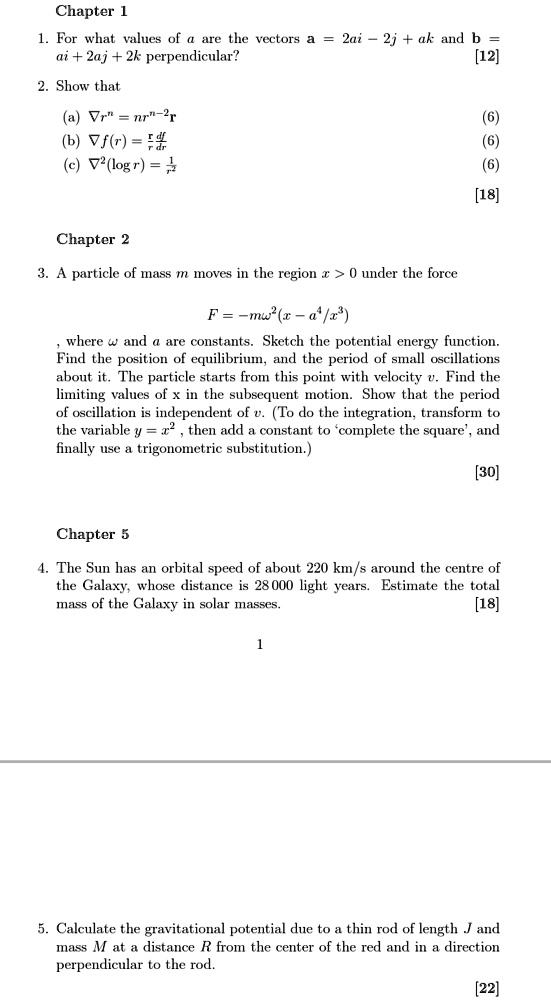
Chapter 1
1. For what values of a are the vectors $\mathbf{a} = 2a\mathbf{i} - 2\mathbf{j} + a\mathbf{k}$ and $\mathbf{b} = a\mathbf{i} + 2a\mathbf{j} + 2\mathbf{k}$ perpendicular?
2. Show that
(a) $\nabla r^n = nr^{n-2}\mathbf{r}$
(b) $\nabla f(r) = \frac{\mathbf{r}}{r} \frac{df}{dr}$
(c) $\nabla^2 (\log r) = \frac{1}{r^2}$
Chapter 2
3. A particle of mass $m$ moves in the region $x > 0$ under the force
$$F = -m\omega^2 (x - a^4/x^3)$$
, where $\omega$ and $a$ are constants. Sketch the potential energy function. Find the position of equilibrium, and the period of small oscillations about it. The particle starts from this point with velocity $v$. Find the limiting values of $x$ in the subsequent motion. Show that the period of oscillation is independent of $v$. (To do the integration, transform to the variable $y = x^2$, then add a constant to 'complete the square', and finally use a trigonometric substitution.)
Chapter 5
4. The Sun has an orbital speed of about 220 km/s around the centre of the Galaxy, whose distance is 28000 light years. Estimate the total mass of the Galaxy in solar masses.
5. Calculate the gravitational potential due to a thin rod of length $J$ and mass $M$ at a distance $R$ from the center of the rod and in a direction perpendicular to the rod.