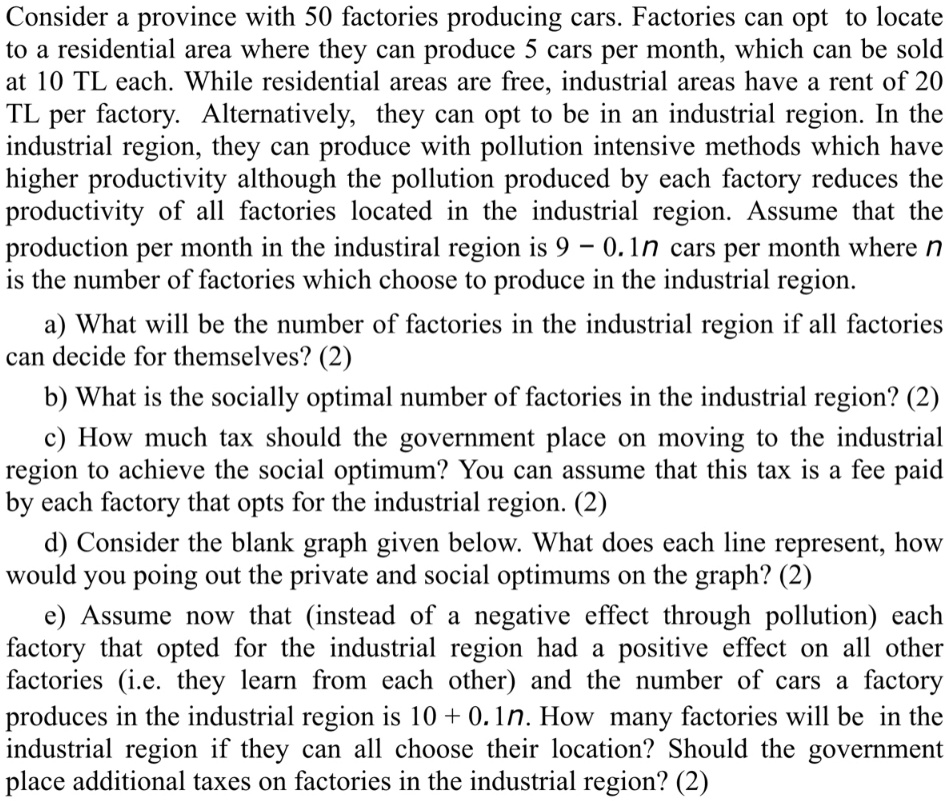
Consider a province with 50 factories producing cars. Factories can opt to locate to a residential area where they can produce 5 cars per month, which can be sold at 10 TL each. While residential areas are free, industrial areas have a rent of 20 TL per factory. Alternatively, they can opt to be in an industrial region. In the industrial region, they can produce with pollution-intensive methods which have higher productivity, although the pollution produced by each factory reduces the productivity of all factories located in the industrial region. Assume that the production per month in the industrial region is 9 - 0.1n cars per month, where n is the number of factories which choose to produce in the industrial region.
a) What will be the number of factories in the industrial region if all factories can decide for themselves? (2)
b) What is the socially optimal number of factories in the industrial region? (2)
c) How much tax should the government place on moving to the industrial region to achieve the social optimum? You can assume that this tax is a fee paid by each factory that opts for the industrial region. (2)
d) Consider the blank graph given below. What does each line represent, how would you point out the private and social optima on the graph? (2)
e) Assume now that (instead of a negative effect through pollution) each factory that opted for the industrial region had a positive effect on all other factories (i.e. they learn from each other) and the number of cars a factory produces in the industrial region is 10 + 0.1n. How many factories will be in the industrial region if they can all choose their location? Should the government place additional taxes on factories in the industrial region? (2)