Ace - AI Tutor
Ask Our Educators
Textbooks
My Library
Flashcards
Scribe - AI Notes
Notes & Exams
Download App
debra zaragoza

debra z.

Divider

Questions asked

BEST MATCH

Source data automation is often effective in reducing A) theft. B) accuracy. C) unintentional errors. D) intentional errors.

View Answer
divider
BEST MATCH

Build a program to play rock - paper- scissor game. The program will randomly generate a number (0, 1, 2) to represent rock, paper, scissor. The program prompts the user to enter a number of 0, 1, or 2. Then displays a message indicating whether the user or the computer wins, loses or draws. Scissor = 0 Rock = 1 Paper = 2 Output should be: Scissor (0), Rock (1), Paper (2): 1 The computer is rock. You are rock too. It is a draw. NOTE: Use both SWITCH and IF statements. Submit .java file via blackboard. Grading Rubric: Comment Header: 8 pts Main Method: 8 pts Correct Decision statement syntax: 16 pts Correct output: 8 pts

View Answer
divider
BEST MATCH

The industrial use transformer that normally has 240 V or 480 V primary and a 120 V secondary is called a(n) _____ transformer.

View Answer
divider
BEST MATCH

Masculine and feminine are the same across cultures (though cultures are different, what counts as masculinity is universal). True False

View Answer
divider
BEST MATCH

You are trying to estimate the value of a single family home. You have found three very good comparable properties to use in the sales comparison approach to valuation. The first comparable property has one more bathroom than the subject property, but one less bedroom than the subject property. Choose the answer below that best describes the adjustments that need to be made to estimate the market value of the subject property. Adjust the comparable up for the value of a bedroom and down for the value of a bathroom. Adjust the subject up for the value of a bedroom and down for the value of a bathroom. Adjust the comparable down for the value of a bedroom and up for the value of a bathroom. Adjust the subject down for the value of a bedroom and up for the value of a bathroom.

View Answer
divider
BEST MATCH

A driver applies the brakes on his car reducing its speed from 31.0 m/s to 11.0 m/s in a time 5.0 secs while traveling a distance of 121 m. What is the magnitude of the car's average acceleration during the 5.0 sec period ? [A] 8.4 m/s² [B] 8.4 m/s [C] 24.2 m/s [D] 4.0 m/s²

View Answer
divider
BEST MATCH

Which is not an accurate statement about thyroid hormones (T3 and T4) and hypothyroidism in children? It is an untreatable condition when detected in neonatal testing (at birth). A fetus is protected by the mother's thyroid hormones (unlike for a newborn child). The condition can result in impaired intellectual development. The condition can result in slowed bone growth and physical stature.

View Answer
divider
BEST MATCH

\int_{-1}^{2} (3u - 5)(u + 2) du Evaluate the integral. \int_{0}^{\pi} f(x) dx \text{ where } f(x) = \begin{cases} \sin(x) & \text{if } 0 \le x < \frac{\pi}{2} \\ \cos(x) & \text{if } \frac{\pi}{2} \le x \le \pi \end{cases} Evaluate the indefinite integral. (Remember to use absolute values where appropriate.) \int \frac{dx}{tx + v} \quad (t \ne 0)

View Answer
divider
BEST MATCH

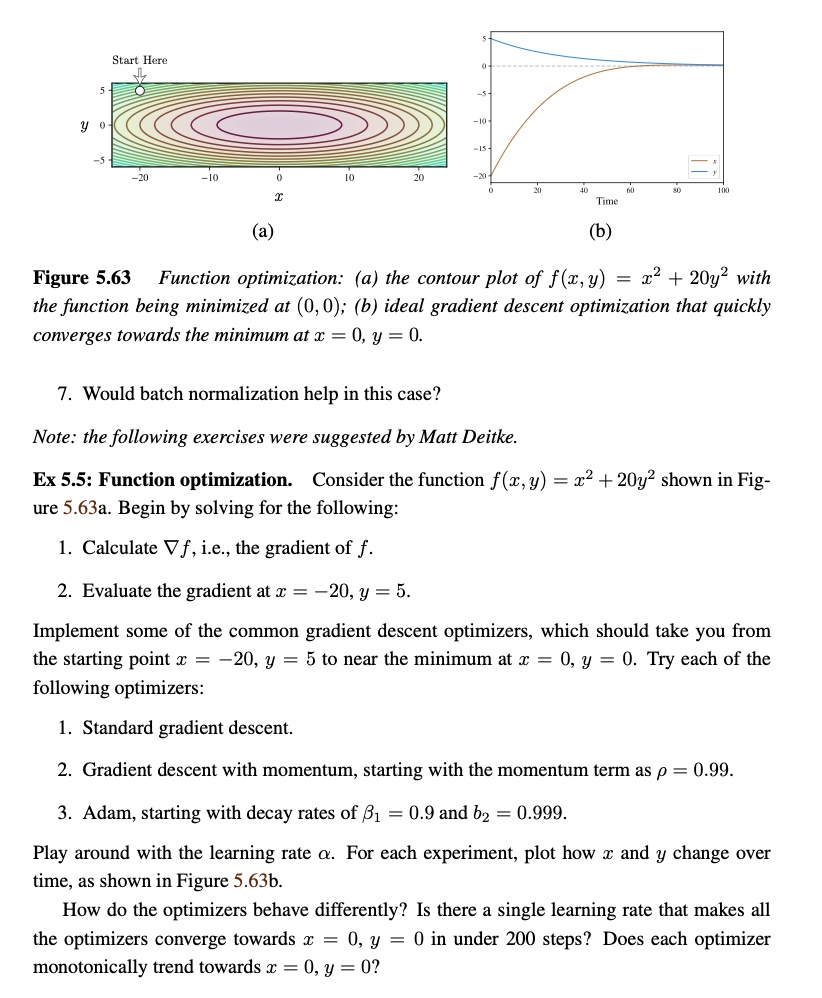
Ex 5.5: Function optimization. Consider the function f(x,y)=x^(2)+20y^(2) shown in Fig- ure 5.63a. Begin by solving for the following: Calculate gradf, i.e., the gradient of f. Evaluate the gradient at x=-20,y=5. Implement some of the common gradient descent optimizers, which should take you from the starting point x=-20,y=5 to near the minimum at x=0,y=0. Try each of the following optimizers: Standard gradient descent. Gradient descent with momentum, starting with the momentum term as ho =0.99. Adam, starting with decay rates of eta _(1)=0.9 and b_(2)=0.999. Play around with the learning rate alpha . For each experiment, plot how x and y change over time, as shown in Figure 5.63b. How do the optimizers behave differently? Is there a single learning rate that makes all the optimizers converge towards x=0,y=0 in under 200 steps? Does each optimizer monotonically trend towards x=0,y=0 ?Figure 5.63 Function optimization: (a) the contour plot of f(x,y)=x^(2)+20y^(2) with the function being minimized at (0,0);(b) ideal gradient descent optimization that quickly converges towards the minimum at x=0,y=0. Would batch normalization help in this case? Note: the following exercises were suggested by Matt Deitke. Ex 5.5: Function optimization. Consider the function f(x,y)=x^(2)+20y^(2) shown in Fig- ure 5.63a. Begin by solving for the following: Calculate gradf, i.e., the gradient of f. Evaluate the gradient at x=-20,y=5. Implement some of the common gradient descent optimizers, which should take you from the starting point x=-20,y=5 to near the minimum at x=0,y=0. Try each of the following optimizers: Standard gradient descent. Gradient descent with momentum, starting with the momentum term as ho =0.99. Adam, starting with decay rates of eta _(1)=0.9 and b_(2)=0.999. Play around with the learning rate alpha . For each experiment, plot how x and y change over time, as shown in Figure 5.63b. How do the optimizers behave differently? Is there a single learning rate that makes all the optimizers converge towards x=0,y=0 in under 200 steps? Does each optimizer monotonically trend towards x=0,y=0 ? Start Her -20 -10 0 10 20 Time (a) (b) Figure 5.63 Function optimization: (a) the contour plot of f(x,y) = x2 + 20y2 with the function being minimized at (0, 0); (b) ideal gradient descent optimization that quickly converges towards the minimum at x = 0, y = 0. 7. Would batch normalization help in this case? Note: the following exercises were suggested by Matt Deitke. Ex 5.5: Function optimization. Consider the function f(x, y) = x2 + 20y2 shown in Fig. ure 5.63a. Begin by solving for the following: 1. Calculate V f, i.e., the gradient of f. 2. Evaluate the gradient at x = --20, y = 5. Implement some of the common gradient descent optimizers, which should take you from the starting point x = -20, y = 5 to near the minimum at = 0, y = 0. Try each of the following optimizers: 1. Standard gradient descent. 2. Gradient descent with momentum, starting with the momentum term as p = 0.99 3. Adam, starting with decay rates of =0.9 and b2=0.999 Play around with the learning rate a. For each experiment, plot how x and y change over time, as shown in Figure 5.63b. How do the optimizers behave differently? Is there a single learning rate that makes all the optimizers converge towards x = 0, y = 0 in under 200 steps? Does each optimizer monotonically trend towards x = 0, y = 0?
View Answer
divider
BEST MATCH

Find an equation $y = f(x)$ for the parametric curve $c(\theta) = (cos(\theta), 5 cos(\theta) + 4 sin^2(\theta))$ and compute $\frac{dy}{dx}$. (Use symbolic notation and fractions where needed.)

View Answer
divider