Ace - AI Tutor
Ask Our Educators
Textbooks
My Library
Flashcards
Scribe - AI Notes
Notes & Exams
Download App
demi williams

demi w.

Divider

Viewed Questions

Charging a capacitor $*$ A battery is connected to an $R C$ circuit, as shown in Fig. 4.42. The switch is initially open, and the charge on the capacitor is initially zero. If the switch is closed at $t=0$, find the charge on the capacitor, and also the current, as functions of time.

Electricity and Magnetism

$r=4$

College Trigonometry

Topics in Analytic Geometry

Introduction to Polar Coordinates

Use an appropriate form of the chain rule to find $d w / d t$.
$$w=5 \cos x y-\sin x z ; x=1 / t, y=t, z=t^{3}$$

Use an appropriate form of the chain rule to find $d w / d t$. $$w=5 \cos x y-\sin x z ; x=1 / t, y=t, z=t^{3}$$

Calculus A New Horizon

Partial Derivatives

Differentiability, Directional…

Draw a contour map of the function showing several level curves.
$ f(x, y) = \sqrt{x} + y $

Draw a contour map of the function showing several level curves. $ f(x, y) = \sqrt{x} + y $

Calculus: Early Transcendentals

Partial Derivatives

Functions of Several Variables

Questions asked

ANSWERED

Brandy Heflin verified

Numerade educator

A small office building air conditioner operates on 480 V AC and consumes 2.54 kW. (a) What is its effective resistance? Ω (b) What is the cost of running the air conditioner during a hot summer month when it is on 8.00 hours per day for 30 days and electricity costs 9.00¢/(kW · h)?

View Answer
divider
ANSWERED

Penny Riley verified

Numerade educator

A cylindrical resistor has a length of 20.0 cm, a cross-sectional area of 1.00 mm2, and a resistivity 6.00 ✕ 10−8 Ω · m. What is the resistance of the wire? (Enter your answer in Ω.)

View Answer
divider
ANSWERED

Vishal Gupta verified

Numerade educator

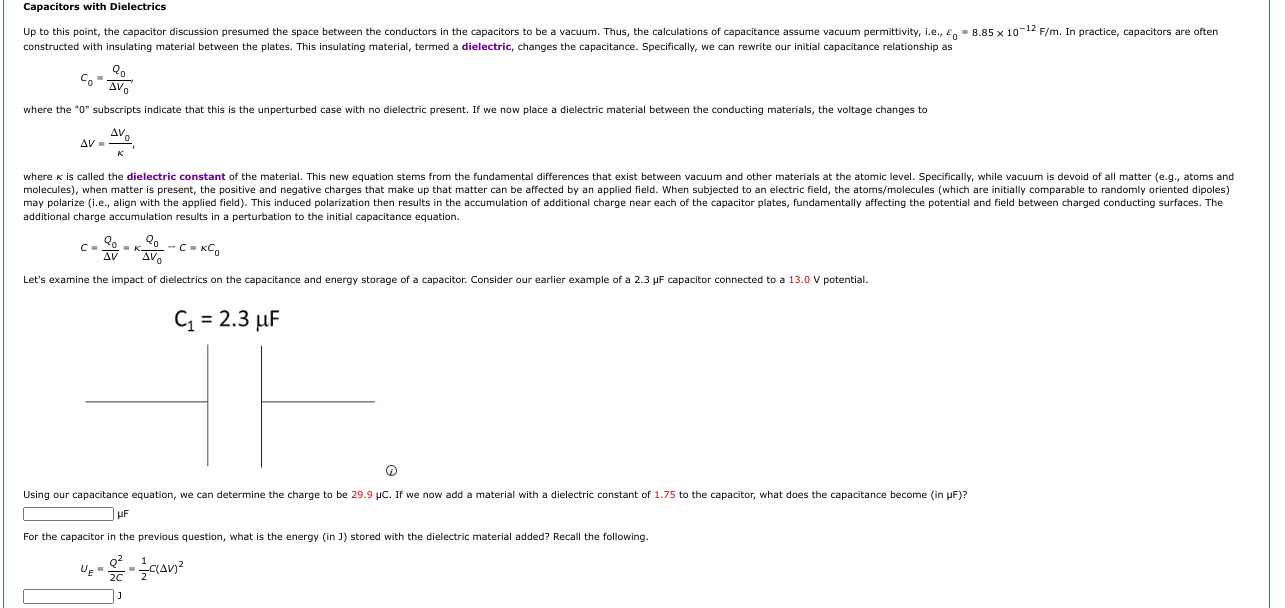
Capacitors with Dielectrics Up to this point, the capacitor discussion presumed the space between the conductors in the capacitors to be a vacuum. Thus, the calculations of capacitance assume vacuum permittivity, i.e., ?? = 8.85 × 10?¹² F/m. In practice, capacitors are often constructed with insulating material between the plates. This insulating material, termed a dielectric, changes the capacitance. Specifically, we can rewrite our initial capacitance relationship as C? = Q? / ?V? where the "0" subscripts indicate that this is the unperturbed case with no dielectric present. If we now place a dielectric material between the conducting materials, the voltage changes to ?V = ?V? / ? where ? is called the dielectric constant of the material. This new equation stems from the fundamental differences that exist between vacuum and other materials at the atomic level. Specifically, while vacuum is devoid of all matter (e.g., atoms and molecules), when matter is present, the positive and negative charges that make up that matter can be affected by an applied field. When subjected to an electric field, the atoms/molecules (which are initially comparable to randomly oriented dipoles) may polarize (i.e., align with the applied field). This induced polarization then results in the accumulation of additional charge near each of the capacitor plates, fundamentally affecting the potential and field between charged conducting surfaces. The additional charge accumulation results in a perturbation to the initial capacitance equation. C = Q? / ?V = ? (Q? / ?V?) ? C = ? C? Let's examine the impact of dielectrics on the capacitance and energy storage of a capacitor. Consider our earlier example of a 2.3 µF capacitor connected to a 13.0 V potential. C? = 2.3 µF Using our capacitance equation, we can determine the charge to be 29.9 µC. If we now add a material with a dielectric constant of 1.75 to the capacitor, what does the capacitance become (in µF)? For the capacitor in the previous question, what is the energy (in J) stored with the dielectric material added? Recall the following. U_E = Q² / 2C = 1/2 C(?V)²
View Answer
divider
ANSWERED

Vishal Gupta verified

Numerade educator

The electric potential in a certain region is represented by the graph shown below. What is the electric force vector on an positron that is at x = 1.30 cm and moving to the right? Express your answer in vector form.

View Answer
divider
ANSWERED

Eduard Sanchez verified

Numerade educator

If you know that the measurements along the 40.0 V line and the 30.0 V line were measured at r = 16.0 cm and r = 12.0 cm, respectively, what is the magnitude of the average electric field (in N/C or V/m) in the region between the two surfaces?

View Answer
divider
ANSWERED

Bcrypt_Sha256$$2B$12$We1Wwocamog01O5I.V2Tkouxdh4Ofnmgpwkor7Leaonfpu0Ubfpua Bcrypt_Sha256$$2B$12$We1Wwocamog01O5I.V2Tkokttmmj7Lscvwvlptp4Rlhbswcdg9.Wy verified

Numerade educator

Solve the system frac{dx}{dt} = x + 2y ; x(0) = 2 using the method of Laplace transforms frac{dy}{dt} = 4x + 3y ; y(0) = 1

View Answer
divider
ANSWERED

Sam Stansfield verified

Numerade educator

For x > 0, find the general solution to x^3 y''' + 6x^2 y'' + 4xy' - 4y = 0

View Answer
divider
ANSWERED

Melissa Munoz verified

Numerade educator

Determine ( mathscr{L}^{-1}left{frac{2 s^{2}+14}{s^{4}+2 s^{3}+4 s^{2}-2 s-5} ight} )

View Answer
divider
ANSWERED

T. L. verified

Numerade educator

Find the general solution for y^ prime prime - 2 * y' + y = (e ^ x)/(1 + x ^ 2)

View Answer
divider
ANSWERED

T. L. verified

Numerade educator

3. Find the general solution to the differential equation (1-2x-x²)y'' + 2(1+x)y' - 2y = 0 when you are given this solution y? = x + 1.

View Answer
divider