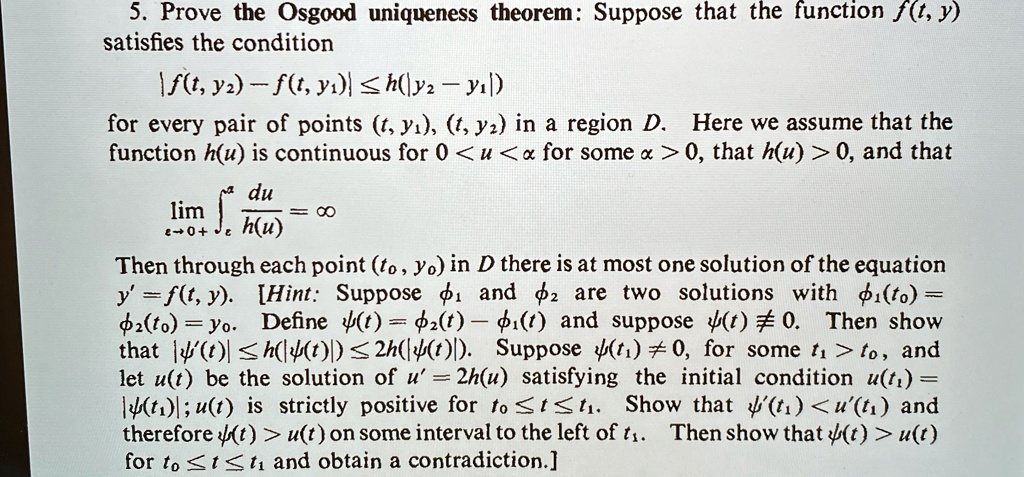
5. Prove the Osgood uniqueness theorem: Suppose that the function $f(t, y)$ satisfies the condition
$|f(t, y_2) - f(t, y_1)| \le h(|y_2 - y_1|)$
for every pair of points $(t, y_1), (t, y_2)$ in a region D. Here we assume that the function $h(u)$ is continuous for $0 < u < \alpha$ for some $\alpha > 0$, that $h(u) > 0$, and that
$\lim_{\epsilon \to 0^+} \int_\epsilon^\alpha \frac{du}{h(u)} = \infty$
Then through each point $(t_0, y_0)$ in D there is at most one solution of the equation
$y' = f(t, y)$. [Hint: Suppose $\phi_1$ and $\phi_2$ are two solutions with $\phi_1(t_0) = \phi_2(t_0) = y_0$. Define $\psi(t) = \phi_2(t) - \phi_1(t)$ and suppose $\psi(t) \ne 0$. Then show that $|\psi'(t)| \le h(|\psi(t)|) \le 2h(|\psi(t)|)$. Suppose $\psi(t_1) \ne 0$, for some $t_1 > t_0$, and let $u(t)$ be the solution of $u' = 2h(u)$ satisfying the initial condition $u(t_1) = |\psi(t_1)|$; $u(t)$ is strictly positive for $t_0 \le t \le t_1$. Show that $\psi'(t_1) < u'(t_1)$ and therefore $\psi(t) > u(t)$ on some interval to the left of $t_1$. Then show that $\psi(t) > u(t)$ for $t_0 \le t \le t_1$ and obtain a contradiction.]