Ace - AI Tutor
Ask Our Educators
Textbooks
My Library
Flashcards
Scribe - AI Notes
Notes & Exams
Download App
denise sanmart-n

denise s.

Divider

Questions asked

BEST MATCH

What muscle groups perform to lift the body while climbing stairs

View Answer
divider
BEST MATCH

A point charge, Q = 4.35 C, is located a distance from an electric dipole along the dipole axis of z = 85.6 m and feels a force due to the dipole of 71.9 mN.a) Calculate the magnitude of the electric field generated by the dipole at the location of the point charge (in kN/C).b) Calculate the magnitude of the dipole moment of the electric dipole (in C·m).c) If the charge on the dipole is q = 4.34 pC, calculate the distance between the two charges in the electric dipole (in nm).

View Answer
divider
BEST MATCH

When consumers choose to not buy products from a certain country because they dislike that specific country (e.g., perhaps due to a recent historical event), this is known as: Group of answer choices antipathy in consumption consumer animosity the love becomes hate effect history specific consumption patterns consumer ethnocentrism

View Answer
divider
BEST MATCH

4. The simply supported beam is subjected to the loading shown. (a) The elastic curve equation. (c) Calculate the maximum deflection of the beam. Use Discontinuity Functions. Answers: $EIv = [-0.5(x)^3 - 0.000741(x)^5 + 0.9(x - 9)^3 + 0.0333(x - 9)^4 + 0.000741(x - 9)^5 + 8.91x]kip - ft^3$

View Answer
divider
BEST MATCH

4. Mystery element X combines with sulfur to form the compound X$_4$S$_3$. The molecular mass of X$_4$S$_3$ is 220.09 amu. Mystery element X is:

View Answer
divider
BEST MATCH

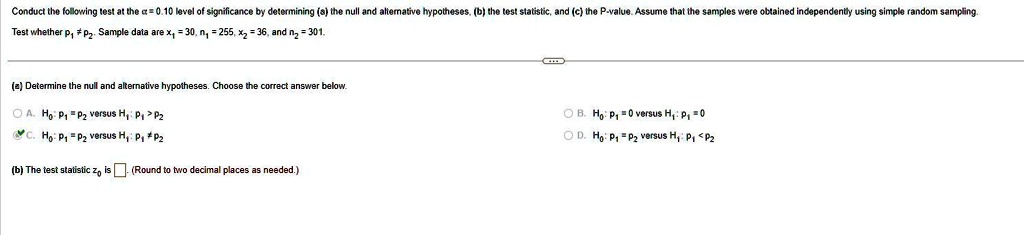
Conduct the following test at the \( \alpha = 0.10 \) level of significance by determining (a) the null and alternative hypotheses, (b) the test statistic, and (c) the P-value. Assume that the samples were obtained independently using simple random sampling. Test whether \( p_1 \ne p_2 \). Sample data are \( x_1 = 30 \), \( n_1 = 255 \), \( x_2 = 36 \), and \( n_2 = 301 \). (a) Determine the null and alternative hypotheses. Choose the correct answer below. OA. \( H_0: p_1 = p_2 \) versus \( H_1: p_1 > p_2 \) OC. \( H_0: p_1 = p_2 \) versus \( H_1: p_1 \ne p_2 \) (b) The test statistic \( z_0 \) is . (Round to two decimal places as needed.) OB. \( H_0: p_1 = 0 \) versus \( H_1: p_1 = 0 \) OD. \( H_0: p_1 = p_2 \) versus \( H_1: p_1 < p_2 \)
View Answer
divider
BEST MATCH

Problem 2: In each of the ideal-diode circuits shown below, $v_1$ is a 10-V peak sine wave. Sketch the waveform resulting at $v_o$ and label the positive and negative peak values.

View Answer
divider
BEST MATCH

The window in a car has a thickness of 7 mm and a thermal conductivity of 1.4 W/mK. In order to prevent condensation, the inner surface temperature of the window must be kept above 15 °C. The outside air is 2 °C with a convection heat transfer coefficient of 50 W/m²K. The inside air is to be maintained at 20 °C with a convection heat transfer coefficient of 5 W/m²K. QUESTION #1 To accomplish this, it is proposed to use a thin electrical surface heater placed on the inner surface of the glass. Determine the rate at which heat that must be supplied in order to prevent condensation on the inner surface. QUESTION #2 An alternate solution to the condensation problem is to generate the heat uniformly within the glass. Determine the rate at which heat must be generated within the glass to prevent condensation. Compare your answer to Question 1, and determine which solution is more economical.

View Answer
divider
BEST MATCH

In comparing the absorption and variable cost methods, each of the following statements is true except: Only the absorption method may be used for external financial reporting. SG&A fixed expenses are not included in inventory in either method. When inventory increases over the period, variable net income will exceed absorption net income. Variable costing charges fixed overhead costs to the period they are incurred.

View Answer
divider
BEST MATCH

Problem 3 Blocks A and B are in contact with each other, at rest on a frictionless horizontal surface. A force of F = 18.0 N is applied as shown below. a) Determine the magnitude of the acceleration of the blocks and the contact force by Block B on Block A. The mass of block A is 4.00 kg and the mass of block B is 8.00 kg. b) Analyze the same problem, but now the Force is applied in the other direction on Block B. Determine the magnitude of the acceleration of the blocks and the contact force by Block B on Block A. The system is initially at rest, F = 18.0 N, the mass of block A is 4.00 kg and the mass of block B is 8.00 kg.

View Answer
divider