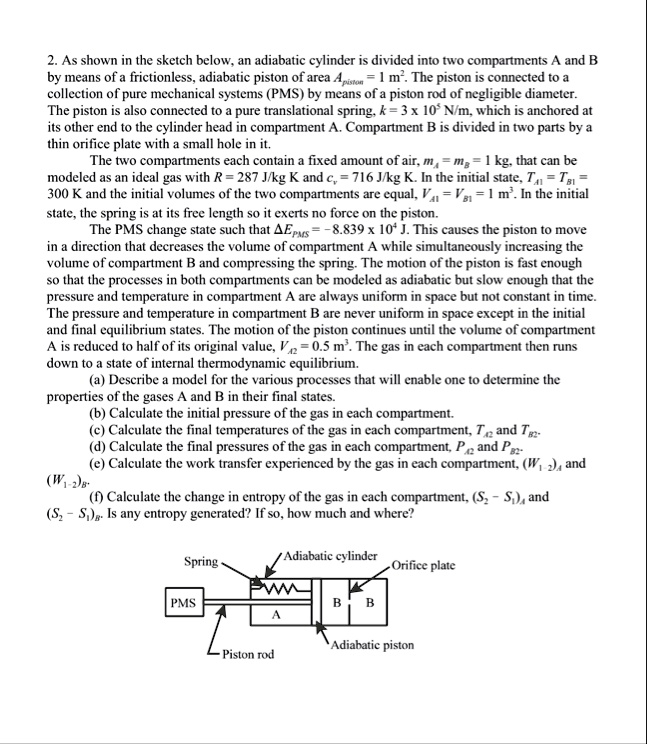
2. As shown in the sketch below, an adiabatic cylinder is divided into two compartments A and B by means of a frictionless, adiabatic piston of area $A_{piston} = 1 \text{ m}^2$. The piston is connected to a collection of pure mechanical systems (PMS) by means of a piston rod of negligible diameter. The piston is also connected to a pure translational spring, $k = 3 \times 10^5 \text{ N/m}$, which is anchored at its other end to the cylinder head in compartment A. Compartment B is divided in two parts by a thin orifice plate with a small hole in it.
The two compartments each contain a fixed amount of air, $m_A = m_B = 1 \text{ kg}$, that can be modeled as an ideal gas with $R = 287 \text{ J/kg K}$ and $c_v = 716 \text{ J/kg K}$. In the initial state, $T_{A1} = T_{B1} = 300 \text{ K}$ and the initial volumes of the two compartments are equal, $V_{A1} = V_{B1} = 1 \text{ m}^3$. In the initial state, the spring is at its free length so it exerts no force on the piston.
The PMS change state such that $\Delta E_{PMS} = -8.839 \times 10^5 \text{ J}$. This causes the piston to move in a direction that decreases the volume of compartment A while simultaneously increasing the volume of compartment B and compressing the spring. The motion of the piston is fast enough so that the processes in both compartments can be modeled as adiabatic but slow enough that the pressure and temperature in compartment A are always uniform in space but not constant in time. The pressure and temperature in compartment B are never uniform in space except in the initial and final equilibrium states. The motion of the piston continues until the volume of compartment A is reduced to half of its original value, $V_{A2} = 0.5 \text{ m}^3$. The gas in each compartment then runs down to a state of internal thermodynamic equilibrium.
(a) Describe a model for the various processes that will enable one to determine the properties of the gases A and B in their final states.
(b) Calculate the initial pressure of the gas in each compartment.
(c) Calculate the final temperatures of the gas in each compartment, $T_{A2}$ and $T_{B2}$.
(d) Calculate the final pressures of the gas in each compartment, $P_{A2}$ and $P_{B2}$.
(e) Calculate the work transfer experienced by the gas in each compartment, $(W_{1-2})_A$ and $(W_{1-2})_B$.
(f) Calculate the change in entropy of the gas in each compartment, $(S_2 - S_1)_A$ and $(S_2 - S_1)_B$. Is any entropy generated? If so, how much and where?
Spring
PMS
Piston rod
Adiabatic cylinder
A
B
B
Orifice plate
Adiabatic piston