Ace - AI Tutor
Ask Our Educators
Textbooks
My Library
Flashcards
Scribe - AI Notes
Notes & Exams
Download App
zurnasever

zurnasever

Divider

Viewed Questions

Anna and Bess are assigned to write a joint paper within a 24 -hour period about the Pareto optimal provision of public goods. Let $t_{A}$ denote the number of hours that Anna contributes to the project and $t_{B}$ the number of hours that Bess contributes. The numeric grade that Anna and Bess earn is a function, $20 \ln \left(t_{A}+t_{B}\right),$ of the total number of hours that they contribute to the project. If Anna contributes $t_{A},$ then she has $\left(24-t_{A}\right)$ hours in the day for leisure. Anna's utility function is $U_{A}=20$ $\ln \left(t_{A}+t_{B}\right)+\ln \left(24-t_{A}\right),$ and Bess' utility func-
tion is $U_{B}=20 \ln \left(t_{A}+t_{B}\right)+\ln \left(24-t_{B}\right) .$ If they
choose the hours to contribute simultaneously and independently, what is the Nash equilibrium number of hours that each will provide? What is the number of hours each should contribute to the project that maximizes the sum of their utilities?

Anna and Bess are assigned to write a joint paper within a 24 -hour period about the Pareto optimal provision of public goods. Let $t_{A}$ denote the number of hours that Anna contributes to the project and $t_{B}$ the number of hours that Bess contributes. The numeric grade that Anna and Bess earn is a function, $20 \ln \left(t_{A}+t_{B}\right),$ of the total number of hours that they contribute to the project. If Anna contributes $t_{A},$ then she has $\left(24-t_{A}\right)$ hours in the day for leisure. Anna's utility function is $U_{A}=20$ $\ln \left(t_{A}+t_{B}\right)+\ln \left(24-t_{A}\right),$ and Bess' utility func- tion is $U_{B}=20 \ln \left(t_{A}+t_{B}\right)+\ln \left(24-t_{B}\right) .$ If they choose the hours to contribute simultaneously and independently, what is the Nash equilibrium number of hours that each will provide? What is the number of hours each should contribute to the project that maximizes the sum of their utilities?

Microeconomics

Externalities, Open-Access, and Public…

Rivalry and Exclusion

Two athletes of equal ability are competing for a prize of \$10,000. Each is deciding whether to take a dangerous performance-enhancing drug. If one athlete takes the drug and the other does not, the one who takes the drug wins the prize. If both or neither take the drug, they tie and split the prize. Taking the drug imposes health risks that are equivalent to a loss of $X$ dollars.
a. Draw a 2 \(\times\) 2 payoff matrix describing the decisions the athletes face.
b. For what $X$ is taking the drug the Nash equilibrium?
c. Does making the drug safer (that is, lowering $X$) make the athletes better or worse off? Explain.

Two athletes of equal ability are competing for a prize of \$10,000. Each is deciding whether to take a dangerous performance-enhancing drug. If one athlete takes the drug and the other does not, the one who takes the drug wins the prize. If both or neither take the drug, they tie and split the prize. Taking the drug imposes health risks that are equivalent to a loss of $X$ dollars. a. Draw a 2 \(\times\) 2 payoff matrix describing the decisions the athletes face. b. For what $X$ is taking the drug the Nash equilibrium? c. Does making the drug safer (that is, lowering $X$) make the athletes better or worse off? Explain.

Principles of Economics

Suppose a single-price monopoly's demand curve is given by $P=20-4 Q,$ where $P$ is price and $Q$ is quantity demanded. Marginal revenue is $M R=20-$ $8 Q .$ Marginal cost is $M C=Q^{2} .$ How much should this firm produce in order to maximize profit?

Suppose a single-price monopoly's demand curve is given by $P=20-4 Q,$ where $P$ is price and $Q$ is quantity demanded. Marginal revenue is $M R=20-$ $8 Q .$ Marginal cost is $M C=Q^{2} .$ How much should this firm produce in order to maximize profit?

Microeconomics: Principles and Applications

Joe has just moved to a small town with only one golf course, the Northlands Golf Club. His inverse demand function is $p=120-2 q,$ where $q$ is the number of rounds of golf that he plays per year. The manager of the Northlands Club negotiates separately with each person who joins the club and can therefore charge individual prices. This manager has a good idea of what Joe's demand curve is and offers Joe a special deal, where Joe pays an annual membership fee and can play as many rounds as he wants at $\$ 20,$ which is the marginal cost his round imposes on the Club. What membership fee would maximize profit for the Club? The manager could have charged Joe a single price per round. How much extra profit does the club earn by using two-part pricing? A

Joe has just moved to a small town with only one golf course, the Northlands Golf Club. His inverse demand function is $p=120-2 q,$ where $q$ is the number of rounds of golf that he plays per year. The manager of the Northlands Club negotiates separately with each person who joins the club and can therefore charge individual prices. This manager has a good idea of what Joe's demand curve is and offers Joe a special deal, where Joe pays an annual membership fee and can play as many rounds as he wants at $\$ 20,$ which is the marginal cost his round imposes on the Club. What membership fee would maximize profit for the Club? The manager could have charged Joe a single price per round. How much extra profit does the club earn by using two-part pricing? A

Microeconomics

Pricing and Advertising

Two-Part Pricing

Questions asked

INSTANT ANSWER

5. (20 points) Consider a market with demand function \( Q=50-\frac{1}{2} P \) and two companies that engage in quantity competition. The total cost function of the first company is \( C_{1}\left(q_{1}\right)=25-q_{1}^{2} \) and for the second it is \( C_{2}\left(q_{2}\right)=q_{2}^{2}-20 q_{2} \). a) Find the Cournot-Nash equilibrium. b) Suppose company 2 gets to move first (Stackelberg leader). What will be the percentage change in the equilibrium quantity of company 2 compared to the Cournot outcome?

View Answer
divider
INSTANT ANSWER

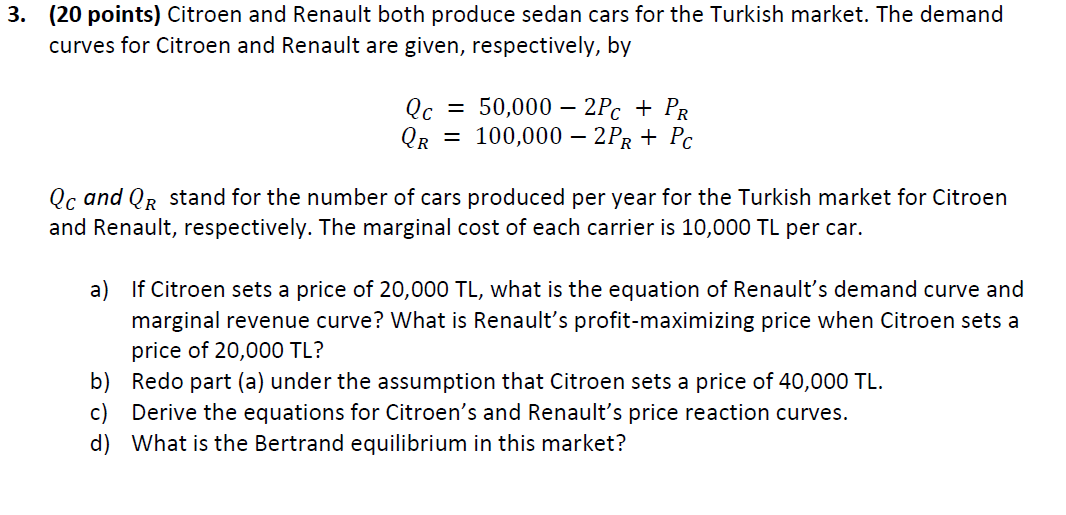
3. (20 points) Citroen and Renault both produce sedan cars for the Turkish market. The demand curves for Citroen and Renault are given, respectively, by \[ \begin{array}{l} Q_{C}=50,000-2 P_{C}+P_{R} \\ Q_{R}=100,000-2 P_{R}+P_{C} \end{array} \] \( Q_{C} \) and \( Q_{R} \) stand for the number of cars produced per year for the Turkish market for Citroen and Renault, respectively. The marginal cost of each carrier is 10,000 TL per car. a) If Citroen sets a price of \( 20,000 \mathrm{TL} \), what is the equation of Renault's demand curve and marginal revenue curve? What is Renault's profit-maximizing price when Citroen sets a price of \( 20,000 \mathrm{TL} \) ? b) Redo part (a) under the assumption that Citroen sets a price of 40,000 TL. c) Derive the equations for Citroen's and Renault's price reaction curves. d) What is the Bertrand equilibrium in this market?
View Answer
divider
INSTANT ANSWER

2. (15 points) The market demand curve for promise is given by \( Q=800-4 P \), where \( Q \) is the promise demanded per day and \( \mathrm{P} \) is the promise price in dollars. Individuals in this industry supply promise every day, and the resulting market price occurs at the point at which the promise demanded equals the total promise supplied. Suppose there are two suppliers in this industry, Cumhuriyet and Hürriyet. Each supplier has an identical constant marginal cost of 125 TL per unit. a) Find the Cournot equilibrium quantities for suppliers. What is the Cournot equilibrium market price? b) Assuming that Hürriyet is the Stackelberg leader, find the Stackelberg equilibrium quantities for each supplier. What is the Stackelberg equilibrium price? c) Calculate and compare the profit of each supplier under the Cournot and Stackelberg equilibria. Under which equilibrium is overall industry profit the greatest, and why?

View Answer
divider
INSTANT ANSWER

1. ( 25 points) An industry consists of two Cournot firms selling a homogeneous product with a market demand curve given by \( P=100-q_{1}-q_{2} \). Each firm has a marginal cost of 10 TL per unit. a) Find the Cournot equilibrium quantities and price. b) Find the quantities and price that would prevail if the firms acted "as if" they were a monopolist (i.e., find the collusive outcome). c) Suppose Firms 1 and 2 sign the following contract. Firm 1 agrees to pay Firm 2 an amount equal to \( K \) liras for every unit of output it (Firm 1) produces. Symmetrically, Firm 2 agrees to pay Firm 1 an amount \( K \) liras for every unit of output it (Firm 2 ) produces. The payments are justified to the government as a cross licensing agreement whereby Firm 1 pays a royalty for the use of a patent developed by Firm 2, and similarly, Firm 2 pays a royalty for the use of a patent developed by Firm 1. What value of \( K \) results in the firms achieving the collusive outcome as a Cournot equilibrium? d) Draw a picture involving reaction functions that shows what is going on in this situation.

View Answer
divider
ANSWERED

Mauya Mitchell verified

Numerade educator

On the eve of a problem-set due date, a professor receives an e-mail from one of her students who claims to be stuck on one of the problems after working on it for more than an hour. The professor would rather help the student if he has sincerely been working. But she would rather not render aid if the student is just fishing for hints. Given the timing of the request, she could simply pretend not to have read the e-mail until later. Obviously, the student would rather receive help whether or not he has been working on the problem. But if help isn't coming, he would rather be working instead of slacking, since the problem set is due the next day. Assume the payoffs are as follows: Student Work and ask for help | Slack and fish for hints Professor | Help Student | 3, 3 | -1, 4 Ignore e-mail | -2, 1 | 0, 0 a) What is the mixed-strategy Nash equilibrium to this game? b) What is the expected payoff to each of the players?

View Answer
divider
INSTANT ANSWER

2. (10 points) On the eve of a problem-set due date, a professor receives an e-mail from one of her students who claims to be stuck on one of the problems after working on it for more than an hour. The professor would rather help the student if he has sincerely been working. But she would rather not render aid if the student is just fishing for hints. Given the timing of the request, she could simply pretend not to have read the e-mail until later. Obviously, the student would rather receive help whether or not he has been working on the problem. But if help isn't coming, he would rather be working instead of slacking, since the problem set is due the next day. Assume the payoffs are as follows: \begin{tabular}{|c|c|c|c|} \cline { 3 - 4 } \multicolumn{2}{c|}{} & \multicolumn{2}{c|}{ Student } \\ \cline { 3 - 4 } \multicolumn{2}{c|}{} & Work and ask for help & Slack and fish for hints \\ \hline \multirow{2}{*}{ Professor } & Help Student & 3,3 & \( -1,4 \) \\ \cline { 2 - 4 } & Ignore e-mail & \( -2,1 \) & 0,0 \\ \hline \end{tabular} a) What is the mixed-strategy Nash equilibrium to this game? b) What is the expected payoff to each of the players?

View Answer
divider
INSTANT ANSWER

2. (10 points) On the eve of a problem-set due date, a professor receives an e-mail from one of her students who claims to be stuck on one of the problems after working on it for more than an hour. The professor would rather help the student if he has sincerely been working. But she would rather not render aid if the student is just fishing for hints. Given the timing of the request, she could simply pretend not to have read the e-mail until later. Obviously, the student would rather receive help whether or not he has been working on the problem. But if help isn't coming, he would rather be working instead of slacking, since the problem set is due the next day. Assume the payoffs are as follows: \begin{tabular}{|c|c|c|c|} \cline { 3 - 4 } \multicolumn{2}{c|}{} & \multicolumn{2}{c|}{ Student } \\ \cline { 3 - 4 } \multicolumn{2}{c|}{} & Work and ask for help & Slack and fish for hints \\ \hline \multirow{2}{*}{ Professor } & Help Student & 3,3 & \( -1,4 \) \\ \cline { 2 - 4 } & Ignore e-mail & \( -2,1 \) & 0,0 \\ \hline \end{tabular} a) What is the mixed-strategy Nash equilibrium to this game? b) What is the expected payoff to each of the players?

View Answer
divider
INSTANT ANSWER

5. (15 points) Let's find the mixed strategy Nash equilibrium of the following game which has no pure strategy Nash equilibrium. \begin{tabular}{|c|c|c|c|c|} \cline { 3 - 5 } \multicolumn{2}{l|}{} & \multicolumn{3}{|c|}{ Player 2 } \\ \cline { 3 - 5 } & & q & \( (1-q) \) \\ \hline \multirow{4}{*}{ Player 1 } & L & R \\ \hline & p & \( \mathrm{U} \) & 3,2 & 1,3 \\ \cline { 2 - 5 } & & & & \\ & (1-p) & \( \mathrm{D} \) & 1,3 & 2,2 \\ \hline \end{tabular} Let \( \mathrm{p} \) be the probability of Player 1 playing \( \mathrm{U} \) and \( \mathrm{q} \) be the probability of Player 2 playing \( \mathrm{L} \) at mixed strategy Nash equilibrium. Our objective is finding \( \mathrm{p} \) and \( \mathrm{q} \).

View Answer
divider
INSTANT ANSWER

David received a parking ticket but feels he did not deserve it! He can either pay it or go to court to contest it. In making his decision, he considers the amount of the ticket (worth 1 point), the time and effort required to contest it (worth 2 points), and how he feels about paying it (worth 5 points). If he pays the ticket, the parking authority receives David’s payment (worth 1 point) and deters unauthorized parking (worth 4 points). However, if David contests the ticket, it would cost the parking authority to defend the ticket in court (worth 3 points). If David wins, it could compromise its deterrent to unauthorized parking. Should David fight the ticket? Use an extensive form game tree to analyze the basic arguments.

View Answer
divider
INSTANT ANSWER

1. (15 points) Find all Nash equilibria in pure strategies in the following non-zero-sum games. Describe the steps that you used in finding the equilibria. Also, state if any player has dominant strategy. \begin{tabular}{|c|c|c|c|} \cline { 3 - 4 } \multicolumn{2}{c|}{} & \multicolumn{2}{c|}{ COLUMN } \\ \cline { 2 - 4 } \multicolumn{2}{c|}{ Left } & Right \\ \hline \multirow{2}{*}{ ROW } & Up & 2,4 & 1,0 \\ \cline { 2 - 4 } & Down & 6,5 & 4,2 \\ \hline \end{tabular} ROW

View Answer
divider