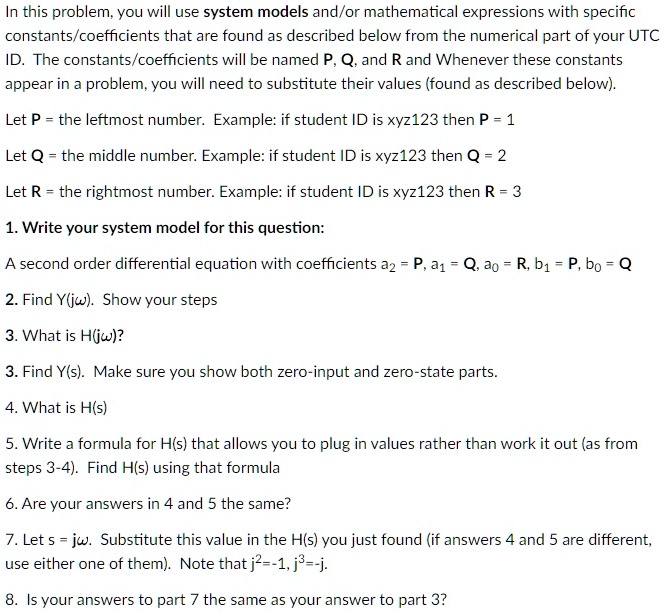
In this problem, you will use system models and/or mathematical expressions with specific constants/coefficients that are found as described below from the numerical part of your UTC ID. The constants/coefficients will be named P, Q, and R and Whenever these constants appear in a problem, you will need to substitute their values (found as described below).
Let P = the leftmost number. Example: if student ID is xyz123 then P = 1.
Let Q = the middle number. Example: if student ID is xyz123 then Q = 2.
Let R = the rightmost number. Example: if student ID is xyz123 then R = 3.
Write your system model for this question:
A second order differential equation with coefficients a2 = P, a1 = Q, a0 = R, b1 = P, b0 = Q.
Find Y(jω). Show your steps.
What is H(jω)?
Find Y(s). Make sure you show both zero-input and zero-state parts.
What is H(s)?
Write a formula for H(s) that allows you to plug in values rather than work it out (as from steps 3-4). Find H(s) using that formula.
Are your answers in 4 and 5 the same?
Let s = jω. Substitute this value in the H(s) you just found (if answers 4 and 5 are different, use either one of them). Note that j^2 = -1, j^3 = -j.
Is your answers to part 7 the same as your answer to part 3?
In this problem, you will use system models and/or mathematical expressions with specific constants/coefficients that are found as described below from the numerical part of your UT ID. The constants/coefficients will be named P, Q, and R and Whenever these constants appear in a problem, you will need to substitute their values (found as described below).
Let P = the leftmost number. Example: if student ID is xyz123 then P = 1.
Let Q = the middle number. Example: if student ID is xyz123 then Q = 2.
Let R = the rightmost number. Example: if student ID is xyz123 then R = 3.
1. Write your system model for this question:
A second order differential equation with coefficients a = P, a = Q, a = R, b = P, b = Q.
2. Find Y(jw). Show your steps.
3. What is H(jw)?
3. Find Y(s). Make sure you show both zero-input and zero-state parts.
4. What is H(s)?
5. Write a formula for H(s) that allows you to plug in values rather than work it out (as from steps 3-4). Find H(s using that formula.
6. Are your answers in 4 and 5 the same?
7. Let s = jw. Substitute this value in the H(s you just found if answers 4 and 5 are different, use either one of them. Note that j = -1, j = -j.
8. Is your answers to part 7 the same as your answer to part 3?