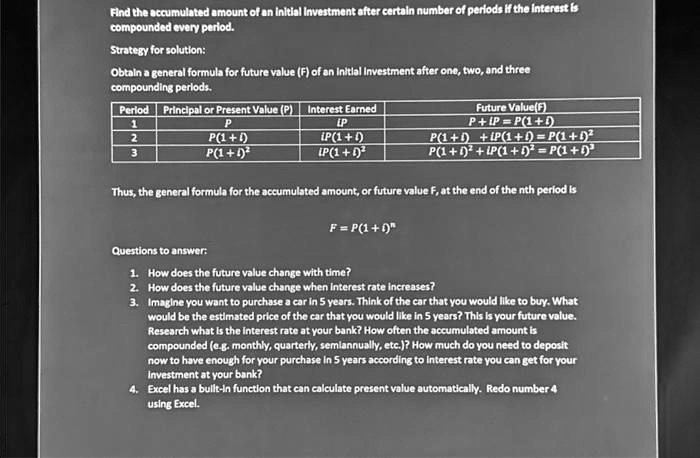
Find the accumulated amount of an initial Investment after certain number of periods if the interest is
compounded every period.
Strategy for solution:
Obtain a general formula for future value (F) of an initial investment after one, two, and three
compounding periods.
Period Principal or Present Value (P) Interest Earned
Future Value(F)
1
P
iP
P + iP = P(1 + i)
2
P(1 + i)
iP(1 + i)
P(1 + i) + iP(1 + i) = P(1 + i)²
3
P(1 + i)²
iP(1 + i)²
P(1 + i)² + iP(1 + i)² = P(1 + i)³
Thus, the general formula for the accumulated amount, or future value F, at the end of the nth period is
F = P(1 + i)$^n$
Questions to answer:
1. How does the future value change with time?
2. How does the future value change when interest rate increases?
3. Imagine you want to purchase a car in 5 years. Think of the car that you would like to buy. What
would be the estimated price of the car that you would like in 5 years? This is your future value.
Research what is the interest rate at your bank? How often the accumulated amount is
compounded (e.g. monthly, quarterly, semiannually, etc.)? How much do you need to deposit
now to have enough for your purchase in 5 years according to interest rate you can get for your
Investment at your bank?
4. Excel has a built-in function that can calculate present value automatically. Redo number 4
using Excel.