QUESTION 3
a) Consider an input signal to a discrete system at a sampling rate of 20 kHz, which comprises a
frequency response $H(n)$, where $H(n)$ represents a high pass filter (HPF). Design a finite impulse
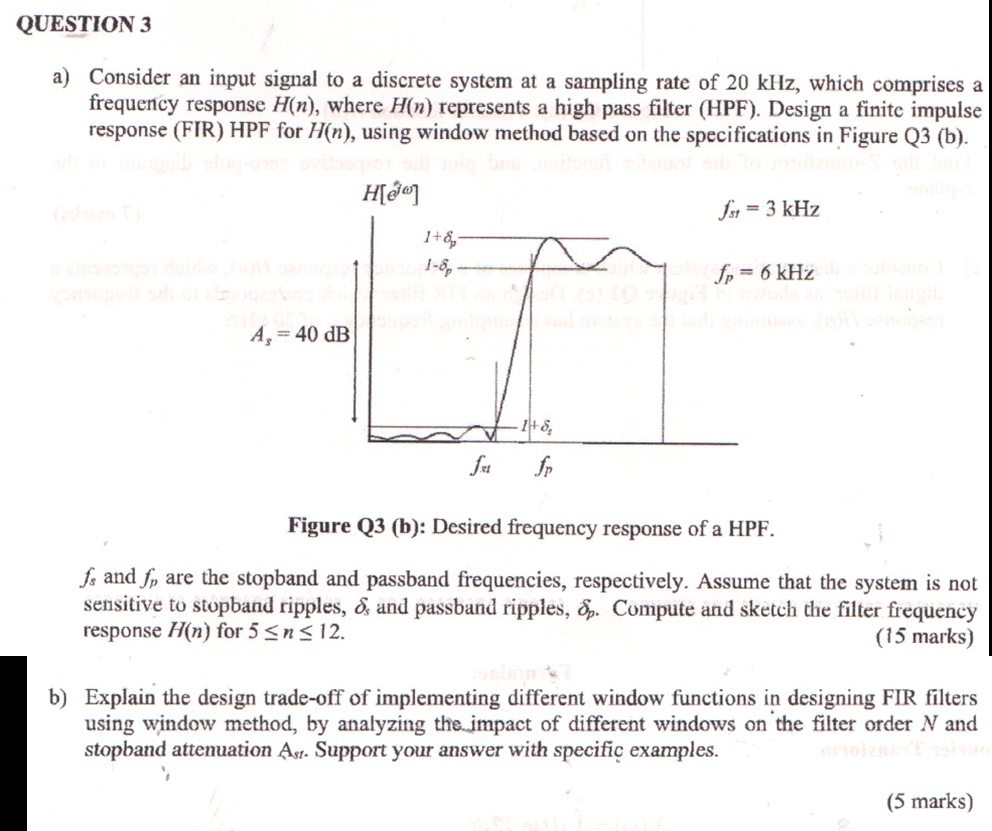
response (FIR) HPF for $H(n)$, using window method based on the specifications in Figure Q3 (b).
$A_s = 40 dB$
$H(e^{j\omega})$
$1 + \delta_p$
$1 - \delta_s$
$1 + \delta_s$
$f_s$
$f_p$
$f_{st} = 3 kHz$
$f_p = 6 kHz$
Figure Q3 (b): Desired frequency response of a HPF.
$f_s$ and $f_p$ are the stopband and passband frequencies, respectively. Assume that the system is not
sensitive to stopband ripples, $\delta_s$ and passband ripples, $\delta_p$. Compute and sketch the filter frequency
response $H(n)$ for $5 \le n \le 12$.
(15 marks)
b) Explain the design trade-off of implementing different window functions in designing FIR filters
using window method, by analyzing the impact of different windows on the filter order N and
stopband attenuation $A_s$. Support your answer with specific examples.
(5 marks)