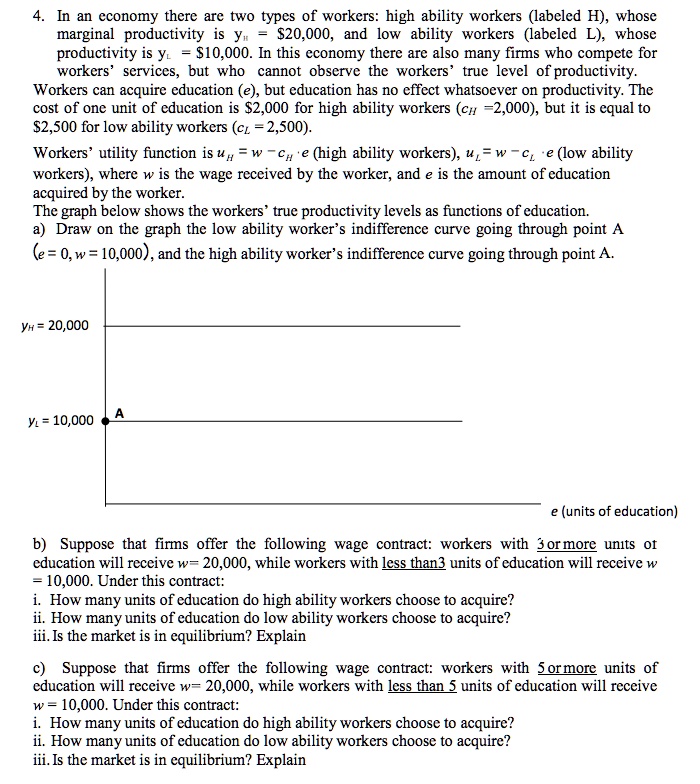
In an economy, there are two types of workers: high ability workers (labeled H), whose marginal productivity is y = $20,000, and low ability workers (labeled L), whose productivity is y = $10,000. In this economy, there are also many firms who compete for workers' services but cannot observe the workers' true level of productivity. Workers can acquire education (e), but education has no effect whatsoever on productivity. The wage received by the worker is denoted as w, and the amount of education acquired by the worker is denoted as e. The workers' utility function is u = w - ce (for high ability workers) and u = w - ce (for low ability workers), where c is a constant. The graph below shows the workers' true productivity levels as functions of education.
a) Draw on the graph the low ability workers' indifference curve going through point A (e = 0, w = 10,000), and the high ability worker's indifference curve going through point A.
y = 20,000
A
y = 10,000
e (units of education)
b) Suppose that firms offer the following wage contract: workers with 3 or more units of education will receive w = 20,000, while workers with less than 3 units of education will receive w = 10,000. Under this contract:
i. How many units of education do high ability workers choose to acquire?
ii. How many units of education do low ability workers choose to acquire?
iii. Is the market in equilibrium? Explain.
c) Suppose that firms offer the following wage contract: workers with 5 or more units of education will receive w = 20,000, while workers with less than 5 units of education will receive w = 10,000. Under this contract:
i. How many units of education do high ability workers choose to acquire?
ii. How many units of education do low ability workers choose to acquire?
iii. Is the market in equilibrium? Explain.