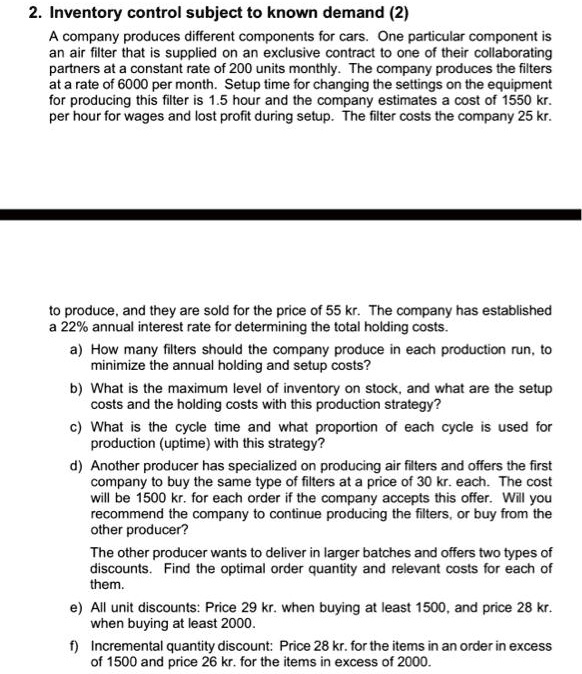
2. Inventory control subject to known demand (2)
A company produces different components for cars. One particular component is
an air filter that is supplied on an exclusive contract to one of their collaborating
partners at a constant rate of 200 units monthly. The company produces the filters
at a rate of 6000 per month. Setup time for changing the settings on the equipment
for producing this filter is 1.5 hour and the company estimates a cost of 1550 kr.
per hour for wages and lost profit during setup. The filter costs the company 25 kr.
to produce, and they are sold for the price of 55 kr. The company has established
a 22% annual interest rate for determining the total holding costs.
a) How many filters should the company produce in each production run, to
minimize the annual holding and setup costs?
b) What is the maximum level of inventory on stock, and what are the setup
costs and the holding costs with this production strategy?
c) What is the cycle time and what proportion of each cycle is used for
production (uptime) with this strategy?
d) Another producer has specialized on producing air filters and offers the first
company to buy the same type of filters at a price of 30 kr. each. The cost
will be 1500 kr. for each order if the company accepts this offer. Will you
recommend the company to continue producing the filters, or buy from the
other producer?
The other producer wants to deliver in larger batches and offers two types of
discounts. Find the optimal order quantity and relevant costs for each of
them.
e) All unit discounts: Price 29 kr. when buying at least 1500, and price 28 kr.
when buying at least 2000.
f) Incremental quantity discount: Price 28 kr. for the items in an order in excess
of 1500 and price 26 kr. for the items in excess of 2000.