The nucleophile in this experiment is ___ and it is from the ____.
Acid Catalyzed Hydrolysis of Epoxides
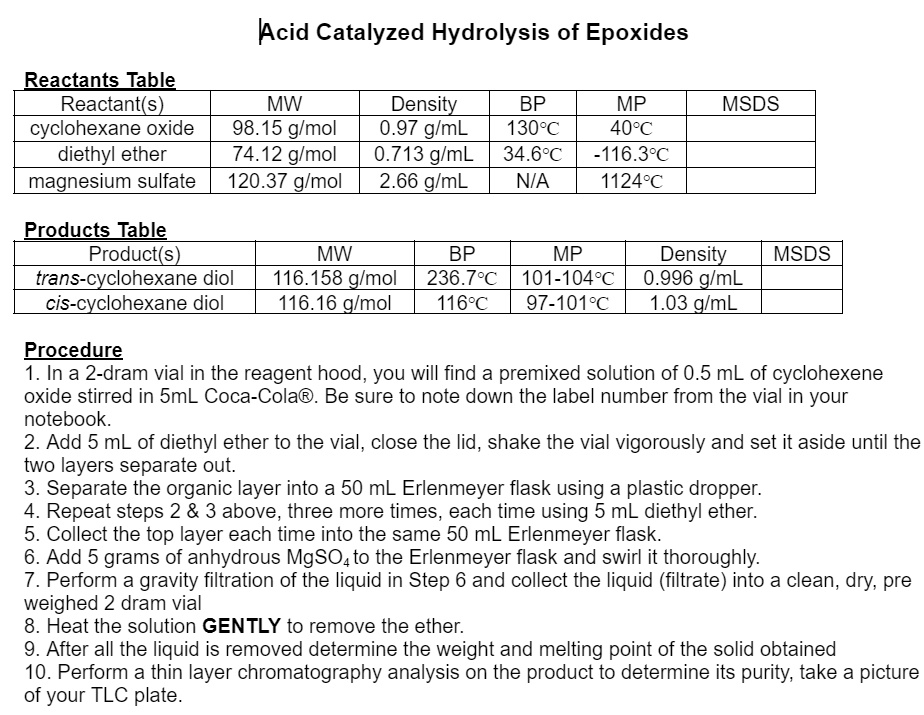
Reactants Table Reactant(s) cyclohexane oxide diethyl ether magnesium sulfate
MW
Density 0.97 g/mL 0.713 g/mL 2.66 g/mL
BP 130°C 34.6°C N/A
MP 40°C -116.3°C 1124°C
MSDS
98.15 g/mol 74.12 g/mol 120.37 g/mol
Products Table Product(s) trans-cyclohexane diol cis-cyclohexane diol
MW
BP
MP
Density 0.996 g/mL 1.03 g/mL
MSDS
116.158 g/mol 116.16 g/mol
236.7°C 116°C
101-104°C 97-101°C
Procedure 1. In a 2-dram vial in the reagent hood, you will find a premixed solution of 0.5 mL of cyclohexene oxide stirred in 5mL Coca-Cola. Be sure to note down the label number from the vial in your notebook. 2. Add 5 mL of diethyl ether to the vial, close the lid, shake the vial vigorously and set it aside until the two layers separate out. 3. Separate the organic layer into a 50 mL Erlenmeyer flask using a plastic dropper. 4. Repeat steps 2 & 3 above, three more times, each time using 5 mL diethyl ether. 5. Collect the top layer each time into the same 50 mL Erlenmeyer flask. 6. Add 5 grams of anhydrous MgSO4 to the Erlenmeyer flask and swirl it thoroughly. 7. Perform a gravity filtration of the liquid in Step 6 and collect the liquid (filtrate) into a clean, dry, pre-weighed 2 dram vial. 8. Heat the solution GENTLY to remove the ether. 9. After all the liquid is removed determine the weight and melting point of the solid obtained. 10. Perform a thin layer chromatography analysis on the product to determine its purity, take a picture of your TLC plate.