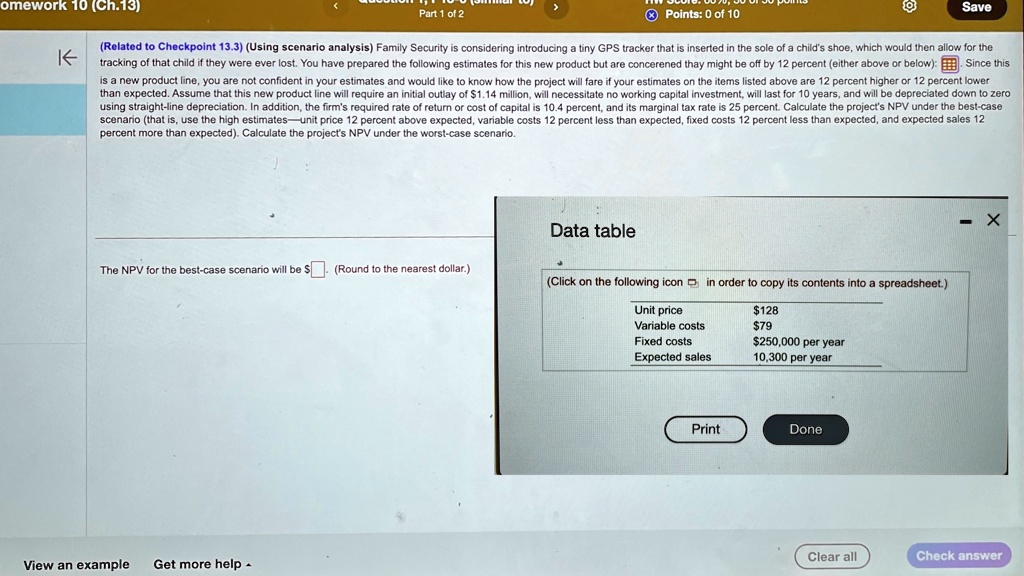
(Related to Checkpoint 13.3) (Using scenario analysis) Family Security is considering introducing a tiny GPS tracker that is inserted in the sole of a child's shoe, which would then allow for the tracking of that child if they were ever lost. You have prepared the following estimates for this new product but are concerened thay might be off by 12 percent (either above or below):. Since this is a new product line, you are not confident in your estimates and would like to know how the project will fare if your estimates on the items listed above are 12 percent higher or 12 percent lower than expected. Assume that this new product line will require an initial outlay of $1.14 million, will necessitate no working capital investment, will last for 10 years, and will be depreciated down to zero using straight-line depreciation. In addition, the firm's required rate of return or cost of capital is 10.4 percent, and its marginal tax rate is 25 percent. Calculate the project's NPV under the best-case scenario (that is, use the high estimates-unit price 12 percent above expected, variable costs 12 percent less than expected, fixed costs 12 percent less than expected, and expected sales 12 percent more than expected). Calculate the project's NPV under the worst-case scenario.
Data table
(Click on the following icon in order to copy its contents into a spreadsheet.)
Unit price $128
Variable costs $79
Fixed costs $250,000 per year
Expected sales 10,300 per year
The NPV for the best-case scenario will be $\$$
(Round to the nearest dollar.)